Noun/Nominal Clause; Cohesive Devices in Paragraph Coherence; Poetry (Selected Non-African Poems) Explained for SHS 2 English Language (Sem. 1 – Week 4)
Language is more than a collection of words. Its meaning depends on how words form clauses, how sentences connect, and how writers use images and structure to communicate experience. These relationships become clear when we examine noun clauses, coherent narrative writing and the poems “Daffodils” by William Wordsworth and “The School Boy” by William Blake.
When a Clause Performs the Work of a Noun
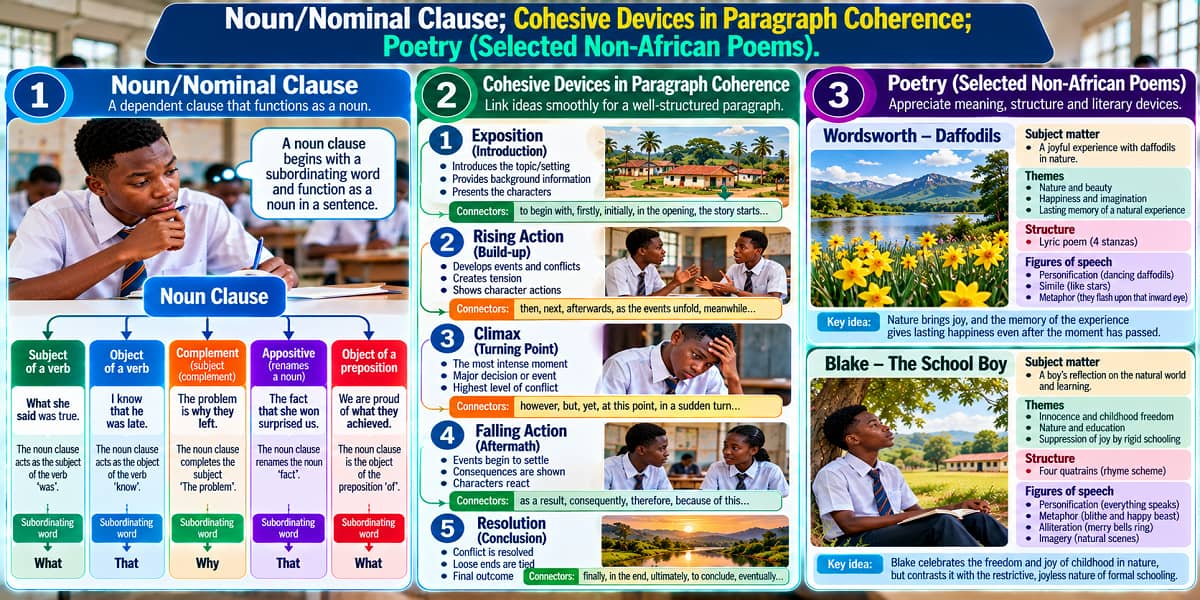
A noun clause is a dependent clause that functions as a noun within a larger sentence. It contains a subject and predicate, yet the entire clause can occupy a position normally associated with a noun phrase. This makes it important for understanding how English expresses ideas, questions, beliefs and information.
Consider What I need to do is to buy some more wood. The clause What I need to do functions as the subject of the verb phrase is to buy some more wood. In I know that he is coming, the clause that he is coming functions as the object of know.
The grammatical name tells us what the structure is; the grammatical function explains what it does in the sentence. Accurate analysis requires both.
| Function | Example | Why it fits |
|---|---|---|
| Subject | Whoever arrives first will get the best seat. | The clause identifies who will receive the seat. |
| Object of a verb | We know where they live. | The clause completes the meaning of know. |
| Complement | The fact is that I am delighted. | The clause completes the meaning of is. |
| Appositive | The rumour, that the company was bankrupt, spread quickly. | The clause explains the content of the rumour. |
| Object of a preposition | I am thinking about what to wear. | The clause follows and completes the preposition about. |
Words such as that, what, which, who, whom, whose, why and how can introduce noun clauses. However, the introductory word alone does not determine the grammatical function. The clause’s position and relationship with the rest of the sentence matter.
How Grammatical Analysis Improves Communication
Recognising noun clauses helps readers interpret longer sentences and helps writers express complex ideas without separating every thought into a short sentence. Compare I wonder. Will they succeed? with I wonder whether they will succeed. The second construction integrates the question into a larger sentence.
When analysing a clause, identify its boundaries, name it and determine its function. For instance, in Why he was crying is unknown to his father, the noun clause Why he was crying functions as the subject of is. In They weren’t sure how they would manage without her, the clause how they would manage without her functions as the complement of the adjective sure in this construction.
These examples show why grammatical function must be considered in context. A clause should not be labelled only by the word that introduces it; its role in the complete sentence is essential.
Coherence: Helping the Reader Follow the Story
Grammar can make individual sentences accurate, but readers also need to understand how one sentence relates to the next. A coherent paragraph develops a unified idea through logical ordering and clear references. Cohesive devices help establish these connections.
Consider a narrative about a family. If each sentence introduces a new event without showing how the events relate, readers may struggle to follow the story. Connectors such as however, besides, moreover, afterwards and as a result can signal contrast, addition, sequence and consequence.
| Writing need | Useful device | Example relationship |
|---|---|---|
| Add information | Moreover, in addition, besides | A second point supports the first. |
| Show contrast | However, on the other hand | A later idea differs from an earlier one. |
| Show consequence | As a result, therefore | One event produces a consequence. |
| Show sequence | First, afterwards, finally | Events occur in an ordered progression. |
Coherence also depends on unity, consistent tense and clear references. Pronouns should make it obvious who or what is being discussed. Repeating a key term can be useful when replacing it with a pronoun might create ambiguity. Connectors must be selected according to meaning, not merely to make writing appear sophisticated.
Why Linear Narrative Structure Matters
A linear narrative presents events in sequence, usually moving from an introduction to a developing conflict and finally to a resolution. Its common elements are exposition, character introduction, setting, rising action, climax, falling action and resolution or denouement.
The story of Kweku Ananse illustrates this pattern. It begins with the family’s daily routine, then introduces Ananse’s habit of eating from the cooking pot before the family meal. The children become hungry, and Ntikuma develops a plan to take yam and hide part of it. The consequences of the plan lead to a confrontation and a lesson about greed.
The sequence allows readers to see how actions produce consequences. Cohesive expressions can make that sequence clearer: however introduces a contrast, as a result signals a consequence, and afterwards indicates what follows. A well-organised narrative does not rely on connectors alone; it also needs relevant events, clear character motivations and a meaningful conclusion.
The moral dimension of the Ananse story emerges from the relationship between behaviour and consequence. Greed contributes to the family’s difficulty, while Ntikuma’s retaliatory plan creates further problems. A reader can therefore consider not only the lesson against greed but also the consequences of responding to wrongdoing through revenge.
Two Poems, Two Views of Human Experience
Poetry appreciation involves examining subject matter, structure, themes and figures of speech. These elements should be interpreted together because imagery and form help a poet develop the poem’s larger meaning.
Wordsworth’s “Daffodils”
In “Daffodils”, the speaker begins by describing loneliness, comparing himself to a cloud that floats over valleys and hills. He then encounters a crowd of golden daffodils beside a lake. Their movement in the breeze is presented as a dance, and the experience creates happiness that remains available through memory.
The poem’s subject matter is the encounter with the flowers and the lasting pleasure it brings. Its major themes include the restorative power of nature, happiness, memory and solitude. The remembered scene becomes a source of comfort when the speaker is alone or reflective.
The poem is organised into four six-line stanzas. Its musical movement complements the flowers’ apparent dancing. A simile appears in “lonely as a cloud”, while personification makes the daffodils seem to dance. The phrase “inward eye” expresses the mind’s power to recall the experience. The flowers therefore represent more than a landscape: they embody a memory capable of renewing joy.
Blake’s “The School Boy”
“The School Boy” begins with a child enjoying a summer morning. Birds sing, the huntsman’s horn sounds, and the skylark provides company. The mood changes when the child must attend school, where the “cruel eye” and anxious atmosphere take away the earlier joy.
The poem explores childhood freedom, the value of joyful learning and the damage that fear can cause. Its subject matter contrasts the child’s delight in nature with an unhappy experience of schooling. The central concern is not simply that school interrupts play; it is that an oppressive learning environment may weaken curiosity and youthful potential.
The poem consists of six five-line stanzas. Its rhetorical questions challenge the reader to consider whether a bird born for joy can sing happily in a cage and whether a child can flourish when troubled by fear. The bird and cage image represents restricted freedom, while the images of buds and blossoms being damaged suggest potential being destroyed before it can mature.
Comparing the Poems
| Aspect | “Daffodils” | “The School Boy” |
|---|---|---|
| View of nature | Nature offers beauty and lasting happiness. | Nature represents freedom and youthful joy. |
| Human experience | A memorable encounter enriches the speaker’s inner life. | An oppressive environment suppresses the child’s happiness. |
| Imagery | Clouds, flowers, stars and dancing waves. | Birds, cages, buds, blossoms and winter. |
| Central concern | The lasting emotional value of a natural experience. | The need to protect childhood joy and potential. |
Both poets use nature to explore human experience, but their emphases differ. Wordsworth celebrates nature’s ability to create a lasting source of pleasure. Blake uses nature to question social conditions that prevent children from flourishing. In each poem, imagery helps communicate a larger idea rather than merely describe the surroundings.
Reading, Writing and Interpretation as Connected Skills
The three focal areas share a practical lesson. A noun clause connects a dependent idea to a larger grammatical structure. Cohesive devices connect sentences and guide the reader through a narrative. Poetry brings together imagery, structure and theme to create a unified artistic experience.
For learners, the benefit is both academic and practical. Understanding noun clauses supports sentence analysis and precise expression. Using connectors appropriately improves essays and storytelling. Appreciating poetry strengthens interpretation by requiring attention to evidence, language and the relationship between details and overall meaning.
When you analyse a sentence, ask what role a clause plays. When you write a paragraph, ask how each sentence contributes to the central idea. When you study a poem, ask how its images and structure communicate its themes. These habits turn grammatical knowledge, writing technique and literary appreciation into usable language skills.
Access NaCCA-aligned Support Packs
Download your structured NaCCA-aligned Teacher Support Pack and Student Learning Pack, designed for clarity, practicality, and reliable teaching and learning.