Noun/Nominal Clause; Cohesive Devices in Paragraph Coherence; Poetry (Selected Non-African Poems)
Language becomes powerful when we understand how its parts work together. A clause can perform the work of a noun, transitional expressions can guide readers through a story, and poetic language can communicate feelings and ideas beyond the literal meaning of words. This lesson develops these abilities through noun clauses, coherent narrative writing and the appreciation of two poems by William Wordsworth and William Blake.
1. Noun or Nominal Clauses
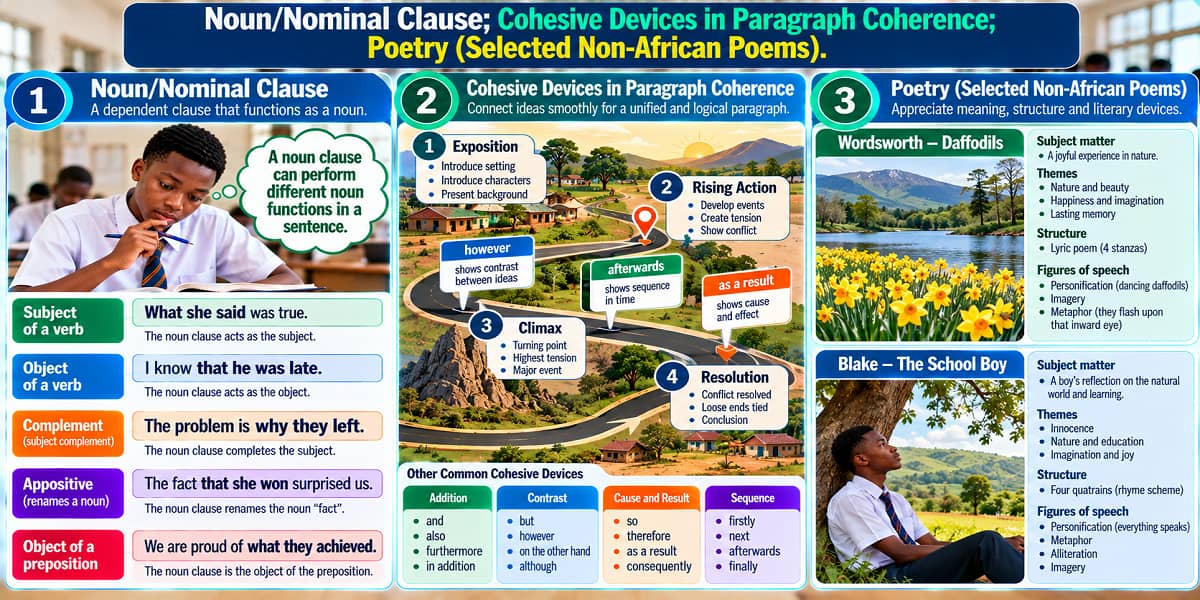
A noun clause, also called a nominal clause (NC), is a dependent clause that functions as a noun in a sentence. Like other clauses, it contains a subject and a predicate, but unlike an ordinary noun, it contains a group of words organised around a verb.
Consider the sentence: What I need to do is to buy some more wood. The words What I need to do form a noun clause. The entire clause functions as the subject of the verb phrase is to buy some more wood.
Noun clauses commonly begin with words such as that, what, which, who, whom, whose, why and how. To analyse one, identify the complete clause, give its grammatical name and then explain its grammatical function in the sentence.
Five grammatical functions of noun clauses
| Function | Example | Explanation |
|---|---|---|
| Subject of a verb | Whoever beat the girl is wrong. | The noun clause is the subject of is. |
| Object of a verb | I know that he is coming. | The clause is the object of know. |
| Complement of a verb | The fact is that I am delighted. | The clause completes the meaning of is. |
| Appositive to a noun | The rumour, that the company was bankrupt, spread quickly. | The clause explains the content of the noun rumour. |
| Object of a preposition | I am thinking about what to wear. | The clause is the object of about. |
How to analyse a noun clause
- Read the entire sentence before identifying the clause.
- Locate the group of words containing a subject and predicate or the relevant dependent-clause construction.
- Identify where the clause begins and ends.
- State the grammatical name: noun clause or nominal clause.
- Ask what work the clause performs in the sentence. Does it act as a subject, object, complement, appositive or object of a preposition?
For example, in We know where they live, the noun clause is where they live. Its grammatical function is the object of the verb know. In Why he was crying is unknown to his father, the clause Why he was crying functions as the subject of is.
Practise grammatical names and functions
Sentence 1: The teacher asked whether we had completed our homework.
Answer: Grammatical name: noun clause, whether we had completed our homework. Grammatical function: object of the verb asked.
Sentence 2: His only concern was where they would stay during the trip.
Answer: Grammatical name: noun clause, where they would stay during the trip. Grammatical function: complement of the verb was.
Sentence 3: Whoever arrives first will get the best seat.
Answer: Grammatical name: noun clause, Whoever arrives first. Grammatical function: subject of the verb phrase will get.
Sentence 4: They were talking about what happened last night.
Answer: Grammatical name: noun clause, what happened last night. Grammatical function: object of the preposition about.
2. Cohesive Devices in Paragraph Coherence
A paragraph may contain grammatically correct sentences and still be difficult to follow if the ideas are poorly connected. Coherence means that the ideas in a paragraph develop clearly and logically around a unified line of thought. Cohesion concerns the language connections that help the sentences hold together.
Cohesive devices include transitional words and expressions, pronouns and direct references to ideas already mentioned. Examples of connectors include besides, in addition, moreover, furthermore, however, again and as a result.
| Relationship | Cohesive devices | Example |
|---|---|---|
| Addition | Besides, in addition, moreover, furthermore | She studied diligently. Moreover, she completed every exercise. |
| Contrast | However, on the other hand | Ananse was greedy. However, his experience taught him a lesson. |
| Result | As a result, therefore | Ntikuma overate. As a result, he became ill. |
| Sequence | First, next, afterwards, finally | First, the characters are introduced. Finally, the conflict is resolved. |
Connectors must express the relationship that actually exists between the ideas. Using however to introduce a consequence, for example, may confuse the reader because the word normally signals contrast. Cohesion is not achieved by inserting as many connectors as possible; it is achieved by choosing appropriate ones.
Features of a coherent paragraph
- Unity: all sentences contribute to one central idea.
- Logical order: events or arguments follow a sensible sequence.
- Clear references: pronouns and repeated key terms help readers identify people, objects and ideas.
- Appropriate transitions: connectors show addition, contrast, cause, result or sequence.
- Consistent tense: verbs make the time relationships clear and avoid confusing shifts.
3. Linear Narrative Essays
A linear narrative essay tells a story in a sequential manner. Events progress from the beginning through the development of a problem or conflict to its resolution. A typical structure includes exposition, introduction of characters, setting, rising action, climax, falling action and resolution or denouement.
| Element | Purpose |
|---|---|
| Exposition | Introduces the background and situation. |
| Characters and setting | Establishes who is involved and where or when the events occur. |
| Rising action | Develops the events and conflict. |
| Climax | Reaches the turning point or most intense moment. |
| Falling action | Shows the consequences following the climax. |
| Resolution or denouement | Brings the main conflict to a conclusion. |
Model: Ananse’s greed and Ntikuma’s plan
In the narrative about Kweku Ananse, his wife Okonore and their children, the exposition introduces the family and its daily routine. The conflict develops when Ananse repeatedly eats food from the cooking pot before the family meal, leaving the children hungry. Ntikuma then devises a plan to take some yam, eat part of it and hide the rest. His actions eventually lead to illness and a family confrontation. The story ends with Ananse learning not to be greedy towards his children.
The sequence demonstrates how character behaviour causes later events. The story’s moral lesson emerges from the consequences of greed and revenge. A reader can follow this development more easily when the narrative uses clear references and appropriate transitions.
Model paragraph using cohesive devices
Kweku Ananse lived with his wife and children in a small town. Every morning, the children accompanied him to the farm, while Okonore prepared food for the family. However, Ananse developed a habit of eating from the cooking pot before mealtime. As a result, the children often had too little food. One day, Ntikuma decided to outsmart his father. Afterwards, his plan caused a confrontation that taught Ananse a lesson about greed.
In this example, however introduces contrast, as a result indicates consequence, and afterwards signals sequence. The expressions guide the reader through connected events rather than leaving the sentences as unrelated statements.
4. Poetry Appreciation: “Daffodils” and “The School Boy”
Poetry appreciation involves analysing and interpreting a poem’s subject matter, structure, themes and figures of speech. A useful interpretation explains how these elements contribute to the poem’s meaning rather than simply listing literary terms.
“Daffodils” by William Wordsworth
The speaker describes wandering alone before encountering a large group of golden daffodils beside a lake and beneath trees. The flowers move in the breeze, appearing to dance. Their beauty leaves a lasting impression that later returns to the speaker’s mind during quiet or reflective moments.
Subject matter: the speaker’s encounter with daffodils and the lasting happiness the memory brings.
Themes: the restorative power of nature, joy, memory and solitude. The experience shows that a beautiful moment can continue to provide pleasure long after it has passed.
Structure: the poem has four six-line stanzas. Its regular rhythm and rhyme help create a flowing musical quality that complements the movement of the flowers.
Figures of speech: the simile “lonely as a cloud” compares the speaker to a cloud. Personification appears when the daffodils are described as “Fluttering and dancing in the breeze”. The phrase “inward eye” suggests the mind’s ability to recall the scene through memory.
“The School Boy” by William Blake
The speaker enjoys a summer morning filled with birdsong and the sounds of nature, but the pleasure disappears when the child has to attend school under a “cruel eye”. The poem questions an educational experience that produces anxiety rather than delight in learning. Images of birds, cages, buds and plants help communicate the child’s loss of freedom and youthful happiness.
Subject matter: a child’s love of nature and freedom contrasted with an unhappy experience of schooling.
Themes: childhood freedom, the value of joy in learning, the harmful effects of fear and the need to nurture young people. The poem asks readers to consider what happens when a child’s natural enthusiasm is suppressed.
Structure: the poem has six stanzas of five lines each. Its questions and changing images develop the speaker’s criticism of an environment that restricts youthful joy.
Figures of speech: the comparison of a child to a bird in a cage suggests restricted freedom. The image of buds being “nipped” and blossoms “blown away” represents the destruction of youthful potential. Rhetorical questions encourage readers to reflect on the consequences of denying children joy.
Compare the poems
| Feature | “Daffodils” | “The School Boy” |
|---|---|---|
| Central experience | A joyful encounter with nature. | A child’s joy in nature contrasted with distress at school. |
| Major themes | Nature, memory, happiness and solitude. | Freedom, childhood, learning and the harm caused by fear. |
| Important imagery | Clouds, golden flowers, stars and dancing waves. | Birds, cages, buds, blossoms and winter. |
| Overall effect | Celebrates nature’s lasting emotional value. | Challenges conditions that suppress youthful joy and development. |
Both poems use nature to communicate ideas about human experience. Wordsworth presents nature as a source of lasting pleasure, while Blake uses natural images to question an environment that limits a child’s happiness and potential.
5. Learner Practice with Answers
Question 1: Identify the noun clause and its function: What she wanted most was peace and quiet.
Answer: What she wanted most is a noun clause functioning as the subject of was.
Question 2: Rewrite the relationship between these ideas using an appropriate connector: “Ananse was greedy. His children became hungry.”
Answer: Ananse was greedy. As a result, his children became hungry.
Question 3: State one major difference between the two poems.
Answer: “Daffodils” celebrates the lasting happiness that nature can bring, while “The School Boy” criticises an experience of schooling that suppresses a child’s joy and freedom.
Question 4: Write a short narrative about an unforgettable school experience using at least three cohesive devices.
Sample answer: Our school organised a sports day that I will never forget. First, we gathered on the field and listened to the instructions. However, my team lost its first race, and we felt disappointed. Later, we worked together and won the relay. As a result, I learnt that teamwork and persistence are important.
6. Final Synthesis
A noun clause functions as a noun and can serve as a subject, object, complement, appositive or object of a preposition. Cohesive devices connect sentences and help a narrative progress logically. Poetry appreciation requires attention to subject matter, structure, themes and figures of speech.
Use these skills together: identify the grammatical role of clauses, make each sentence contribute to a unified paragraph, and explain how a poet’s language creates meaning. Careful analysis strengthens both communication and interpretation.
Access NaCCA-aligned Support Packs
Download your structured NaCCA-aligned Teacher Support Pack and Student Learning Pack, designed for clarity, practicality, and reliable teaching and learning.