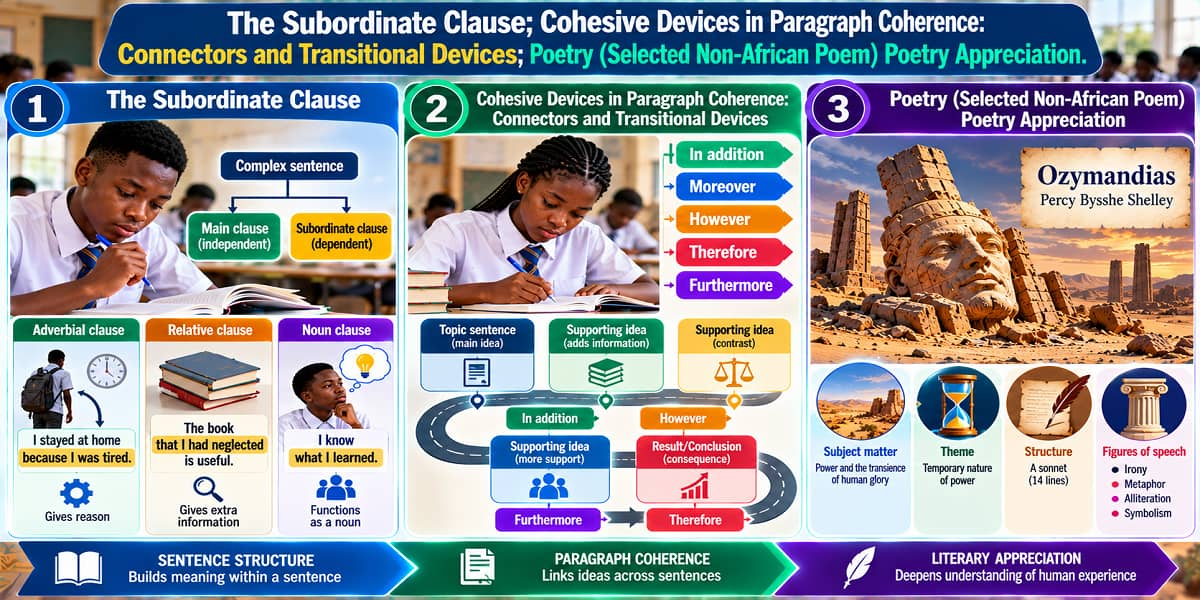
The Subordinate Clause; Cohesive Devices in Paragraph Coherence: Connectors and Transitional Devices; Poetry (Selected Non-African Poem) Poetry Appreciation
This week connects three important language skills: recognising subordinate clauses, building coherent paragraphs, and appreciating poetry. In each case, the goal is to understand how individual parts of language work together to create complete meaning.
1. The Subordinate Clause
A subordinate clause, also called a dependent clause, is a clause that cannot stand alone as a complete sentence. It depends on a main or independent clause to make complete sense.
Compare these two parts:
I went to bed early — this can stand alone.
because I was tired — this cannot stand alone as a complete sentence.
When they are joined, the meaning is complete:
I went to bed early because I was tired.
Words that introduce subordinate clauses
Subordinate clauses are often introduced by subordinating conjunctions such as because, since, after, although, though, unless, until, if, when, whenever, while, whether, so that, where, wherever, as and before.
They may also begin with dependent words such as what, when, where, why and how.
Three main types
| Type | Function | Example |
|---|---|---|
| Adverbial clause | Modifies a verb, adverb or adjective. | Because I was tired, I went to bed. |
| Relative clause | Qualifies a noun or pronoun. | The chapter that I had neglected was crucial. |
| Noun clause | Functions as a noun. | What I learned was important. |
How to identify one
- Look for a subordinating conjunction or dependent word.
- Check whether the group of words contains a subject and predicate.
- Ask whether it can stand alone as a complete sentence.
- Identify its grammatical function.
For example:
- Since I had a meeting, I woke up early. — Adverbial clause.
- If I study hard, I will pass the exam. — Adverbial clause.
- The chapter that I had neglected was crucial. — Relative clause.
- What I needed was a break. — Noun clause.
2. Making Paragraphs Coherent
Good writing is not simply a collection of correct sentences. The sentences must work together so that the reader can follow the writer’s thought.
Paragraph coherence is the ability of a paragraph to communicate its meaning clearly and effectively, with its sentences working together to convey a unified idea or flow of thought.
Four features of a coherent paragraph
| Feature | Meaning |
|---|---|
| Unity | All sentences relate to one main idea or topic. |
| Cohesion | Sentences are connected using transitional words, phrases and pronouns. |
| Logical order | Ideas follow a sensible sequence, with each sentence building on the previous one. |
| Clear relationships | Words and phrases make the relationships between ideas clear. |
Cohesive devices
Cohesive devices are words or phrases that connect ideas and make writing more coherent and logical. They are also called linking words and expressions, connectors or discourse markers.
For example:
The road was flooded. Therefore, the students arrived late.
The connector therefore shows the relationship between the flooded road and the result.
Other useful expressions include however for contrast and in addition, besides, moreover and furthermore for adding information.
How to build coherence
- Begin with a clear topic sentence.
- Use transitional words and expressions to connect ideas.
- Repeat important key words and phrases where appropriate.
- Use pronouns to refer to previously mentioned ideas or people.
- Maintain a consistent verb tense.
3. Practise Building a Coherent Paragraph
Suppose you are writing about the importance of education. A paragraph should not jump randomly from one idea to another. Begin with a central idea, develop it with supporting ideas, and use connectors to show how the ideas relate.
Example: Education provides knowledge and skills for individuals. In addition, it can help learners develop the ability to reason and solve problems. Furthermore, education can prepare people to participate meaningfully in society. Therefore, access to quality education is important for individual and social development.
Notice the progression: central idea → supporting idea → additional support → conclusion.
4. Poetry Appreciation
Poetry appreciation involves analysing and interpreting the meaning, themes and literary devices used in a poem.
Four important elements to examine are subject matter, structure, themes and figures of speech.
| Element | What to examine |
|---|---|
| Subject matter | The underlying idea, message or general meaning conveyed by the poem. |
| Structure | How the elements of the poem are organised and arranged. |
| Theme | The central idea or insight the poem communicates. |
| Figures of speech | Expressive techniques that add meaning, imagery, depth and emphasis. |
5. Appreciating Ozymandias
Ozymandias by Percy Bysshe Shelley is a sonnet about the impermanence of human achievements and the passage of time.
The poem describes a traveller who encounters the ruins of a colossal statue in the desert. The statue has “trunkless legs of stone” and a “shattered visage”. On the pedestal appears the proud declaration:
“My name is Ozymandias, king of kings:
Look on my Works, ye Mighty, and despair!”
The powerful claim contrasts sharply with the reality surrounding the ruined statue: “Nothing beside remains.”
Subject matter
The poem presents the remains of a once-powerful ruler and contrasts his enormous pride with the destruction of his statue and empire. The contrast highlights the eventual decay and oblivion of human power.
Central theme
The central theme is the transience of human achievements and the inevitable decline of earthly power and glory. The poem suggests that even mighty rulers and their empires cannot escape the passage of time.
Other themes include:
- The illusion of power: Ozymandias possessed power, but it did not last.
- The vastness of nature: the surrounding desert contrasts with the ruined statue.
- The survival of art: although Ozymandias has disappeared, the artistic representation remains.
- Futility: the pursuit of power and glory is fleeting.
Structure
Ozymandias is a sonnet consisting of fourteen lines and using iambic pentameter. It is divided into an octet of eight lines and a sestet of six lines. The rhyme scheme given in the material is ABABACDCEDEFEF.
Figures of speech
- Irony: Ozymandias commands others to admire his works, yet almost nothing remains.
- Metaphor: the ruined statue represents the decay of human power and pride.
- Alliteration: “sneer of cold command” creates a harsh sound that reinforces the ruler’s character.
- Symbolism: the statue symbolises the rise and fall of civilisations and the temporary nature of earthly power.
6. A Simple Method for Poetry Appreciation
- Read the poem carefully. Pay attention to its words, punctuation and sound.
- Identify the subject matter. Ask what the poem is about.
- Find the themes. Ask what larger ideas the poet communicates.
- Examine the structure. Consider form, organisation and arrangement.
- Identify figures of speech. Explain how each contributes to meaning.
- Connect the elements. Show how subject matter, theme, structure and language work together.
7. Learner Practice
Question 1: Explain a subordinate clause in your own words.
Answer: A subordinate clause is a dependent clause that cannot stand alone as a complete sentence and depends on a main clause for complete meaning.
Question 2: Identify the subordinate clause in: Although I was tired, I finished my studies.
Answer: Although I was tired.
Question 3: What is paragraph coherence?
Answer: It is the ability of a paragraph to communicate meaning clearly and effectively, with its sentences working together around a unified idea or flow of thought.
Question 4: Give three cohesive devices or linking expressions.
Answer: However, therefore, furthermore. Other appropriate examples include in addition, besides and moreover.
Question 5: Name four elements to consider when appreciating a poem.
Answer: Subject matter, structure, themes and figures of speech.
8. Synthesis
A subordinate clause depends on another clause for complete meaning. Cohesive devices connect ideas so that paragraphs develop logically and coherently. Poetry appreciation requires readers to move beyond the surface of a poem and examine its subject matter, structure, themes and figures of speech.
Across all three areas, the same principle applies: meaning depends on relationships. Words form clauses; clauses form connected ideas; and poetic elements work together to create a larger message.
Access NaCCA-aligned Support Packs
Download your structured NaCCA-aligned Teacher Support Pack and Student Learning Pack, designed for clarity, practicality, and reliable teaching and learning.