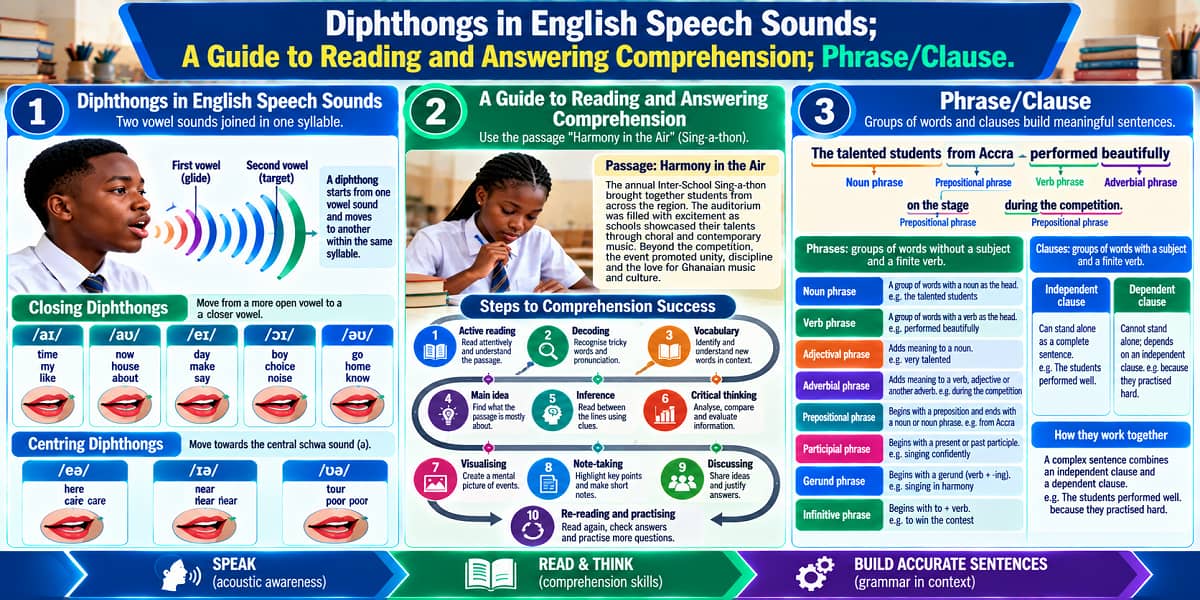
Diphthongs in English Speech Sounds; A Guide to Reading and Answering Comprehension; Phrase/Clause Explained for SHS 2 English Language (Sem. 1 – Week 1)
Good communication is not one skill. It is a combination of hearing and producing sounds accurately, understanding messages, and organising words so that ideas are clear. Three areas in SHS 2 English Language Week 1 illustrate this connection particularly well: diphthongs, reading comprehension, and phrases and clauses.
The Movement Inside a Diphthong
When you pronounce a diphthong, the vowel sound does not remain fixed. It glides from one vowel sound to another. That is why diphthongs are also called glides.
The week’s examples include /aɪ/ in high and buy, /aʋ/ in now and pound, /eɪ/ in day and bake, /ɔɪ/ in boy and noise, and /ǝʋ/ in go and home. The centring group consists of /eǝ/, /ɪǝ/ and /uǝ/.
| Group | Diphthongs | Examples |
|---|---|---|
| Closing | /aɪ/, /aʋ/, /eɪ/, /ɔɪ/, /ǝʋ/ | high, now, day, boy, home |
| Centring | /eǝ/, /ɪǝ/, /uǝ/ | air, ear, pure |
The practical lesson is simple: when reading aloud, pay attention to the glide rather than treating the sound as a single unchanging vowel.
Reading Is More Than Seeing Words
A reader can pronounce every word in a passage and still fail to understand it. Reading comprehension requires the reader to construct meaning.
The process begins with decoding and vocabulary, but it goes further. A strong reader also reads fluently, thinks critically and makes inferences.
This means a comprehension question may require more than locating an identical sentence in the passage. You may need to connect details, interpret an expression, identify the writer’s purpose or evaluate what the text communicates.
A practical reading cycle
- Before reading: activate what you already know and consider the purpose for reading.
- During reading: identify important ideas, ask questions, visualise and take notes.
- After reading: summarise, discuss, re-read difficult sections and test your interpretation.
The recommended strategies include active reading, visualising, making connections, note-taking, discussing, re-reading, practising and cross-referencing.
Reading a Passage from More Than One Angle
The passage Harmony in the Air uses Sing-a-thons to present contrasting experiences. Music brings people together, creates opportunities for performers and encourages community support. At the same time, competition can produce rivalry, pressure, vocal strain, anxiety, ticket difficulties and intense public scrutiny.
That makes the passage useful for practising several levels of comprehension. A reader can locate information, interpret vocabulary such as transcend, infectious and clamours, interpret figurative language, identify positive and negative effects, and explain the meaning of the expression “harmonious and discordant aspects.”
The larger principle is transferable: good comprehension combines information retrieval with interpretation and reasoning.
The Architecture of a Sentence
Grammar provides another way of looking closely at language. A phrase is a grammatical unit, while a clause contains a subject and a predicate.
Consider how much information can be built into a sentence:
Having finished my homework, I went to the store to buy some milk.
The sentence contains a participial phrase, an independent clause and an infinitive phrase. Recognising these structures makes it easier to see how the writer has organised the information.
Different phrases, different jobs
| Structure | Its communicative role |
|---|---|
| Noun phrase | Can identify a person, thing or idea and function as subject, object, complement, appositive or object of a preposition. |
| Verb phrase | Expresses the verb or series of verbs functioning as the verb part of a clause. |
| Adjectival phrase | Qualifies a noun or pronoun. |
| Adverbial phrase | Adds information about manner, time, place, frequency or degree. |
| Prepositional phrase | Expresses relationships such as location, direction, time or manner. |
| Participial phrase | Qualifies a noun or pronoun. |
| Gerund phrase | Functions as a noun and can be a subject, complement or object. |
| Infinitive phrase | Can function as a noun, adjective or adverb and can express purpose, intent or direction. |
| Absolute phrase | Adds information about the sentence or clause as a whole. |
Clause: The Difference That Matters
A clause contains a subject and a predicate. An independent clause can stand alone, while a dependent clause relies on an independent clause.
In I went to the store because I needed milk, I went to the store is the independent clause and because I needed milk is the dependent clause.
This distinction becomes especially useful when analysing longer sentences because it helps you see how ideas are connected.
One Week, Three Connected Language Skills
Diphthongs, comprehension and grammar may initially appear to belong to separate parts of English Language. In practice, they meet whenever you communicate.
You use speech sounds when you speak. You use comprehension strategies when you listen to or read a message. You use phrases and clauses whenever you organise your response.
That is why improving English is not simply a matter of learning more vocabulary. It also involves understanding how sounds carry words, how readers construct meaning, and how grammatical structures carry relationships between ideas.
When these skills work together, language becomes more precise in both speech and writing.
Access NaCCA-aligned Support Packs
Download your structured NaCCA-aligned Teacher Support Pack and Student Learning Pack, designed for clarity, practicality, and reliable teaching and learning.