The Origin And Development Of The Earliest Domestic And External Forms Of Trade In Africa
Introduction
Trade in Africa began thousands of years ago through internal exchanges among local communities and later developed into extensive external trade networks connecting Africa to North Africa and the Mediterranean world. Trade promoted economic activities, cultural interactions, political influence, and the growth of powerful African kingdoms.
Key Concepts
- Trade: The exchange of goods and services between people or regions.
- Barter System: A form of trade in which goods are exchanged directly without money.
- Internal Trade: Trade carried out within local communities and regions in Africa.
- External Trade: Trade conducted between Africa and other regions.
- Trans-Saharan Trade: Long-distance trade linking West Africa with North Africa and the Mediterranean.
- Legal Tender: Official items accepted for payment during trade.
- Economic Prosperity: Increased wealth and economic growth resulting from trade activities.
- Cultural Exchange: The sharing of beliefs, customs, ideas, and practices among societies.
Explanation
The earliest forms of trade in Africa developed through the exchange of goods among local communities. These exchanges were mainly based on the barter system, where goods and services were exchanged directly without the use of money.
Internal or domestic trade involved the exchange of commodities such as foodstuffs, livestock, minerals, cloth, kola nuts, salt, and craft products. This trade promoted economic activities and cultural interactions within different regions of Africa.
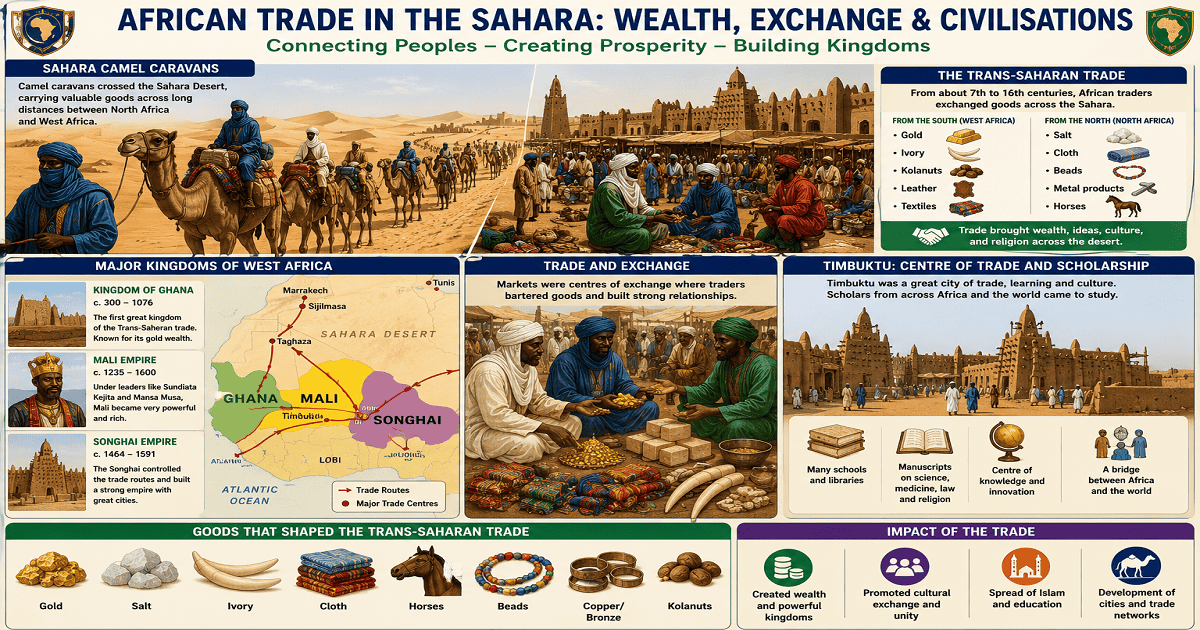
External trade later emerged as African communities established connections with North Africa and other regions. The most important external trade network was the Trans-Saharan Trade, which connected West Africa with North Africa and the Mediterranean. Goods traded included gold, salt, ivory, and slaves.
Several factors influenced the development of trade in Africa:
- Geographical features such as rivers, coastlines, and deserts
- Availability of valuable resources like gold, salt, and spices
- The rise of complex societies and urban centres
- Cultural exchange and the spread of ideas
Trade routes expanded gradually over time, and trade networks became more organised and sophisticated. These developments contributed to economic growth and cultural diversity across Africa.
The Trans-Saharan Trade had major effects on African kingdoms such as Ghana, Mali, and Songhai. These kingdoms became economically prosperous because they controlled important trade routes and imposed taxes on traded goods.
Trade also encouraged cultural exchange between North Africa and Sub-Saharan Africa. Islam spread into many African societies through Muslim traders who travelled along trade routes. This led to the adoption of Islamic customs, practices, and architecture.
Political influence increased as kingdoms gained power through control of trade routes and trade partnerships. Powerful rulers expanded their territories and established strong centralised states.
Urbanisation developed because wealth generated from trade supported the construction of markets, mosques, and fortifications. Cities such as Timbuktu became famous centres of trade, scholarship, and culture.
Trade also brought social changes. Merchants and traders gained wealth and influence, while labour demands in trade activities encouraged migration and the growth of diverse social structures.
Forms Of Trade In Pre-Colonial Africa
| Type Of Trade | Characteristics | Examples Of Goods |
|---|---|---|
| Internal Trade | Trade within local communities and regions | Foodstuffs, livestock, cloth, kola nuts |
| External Trade | Trade between Africa and other regions | Gold, ivory, slaves, salt |
| Barter Trade | Exchange of goods without money | Salt exchanged for gold |
| Trans-Saharan Trade | Long-distance desert trade routes | Gold, salt, spices, ivory |
Effects Of The Trans-Saharan Trade
| Effect | Description | Impact On African Kingdoms |
|---|---|---|
| Economic Prosperity | Generation of wealth through taxation and trade | Growth of Ghana, Mali, and Songhai |
| Cultural Exchange | Spread of Islam and cultural practices | Development of Islamic traditions |
| Political Influence | Control of trade routes increased power | Expansion of kingdoms |
| Urbanisation | Growth of cities and infrastructure | Rise of Timbuktu as a trade centre |
| Social Changes | Movement of people and social mobility | Diverse social structures emerged |
Examples
Example 1
Problem: Explain why the Trans-Saharan Trade became important in Africa.
- Identify the trade routes involved.
- Determine the goods exchanged.
- Explain the economic and cultural benefits.
Final Answer: The Trans-Saharan Trade became important because it connected West Africa with North Africa, promoted trade in valuable goods, and encouraged economic growth and cultural exchange.
Example 2
Problem: Explain how trade contributed to the growth of Timbuktu.
- Identify Timbuktu’s role in trade.
- Determine how trade generated wealth.
- Explain the cultural importance of the city.
Final Answer: Timbuktu became wealthy and developed into a centre of trade, scholarship, and culture because of its location along major trade routes.
Application and Activities
- Discuss the barter system and forms of trade in pre-colonial Africa.
- Create multimedia presentations on the effects of the Trans-Saharan Trade.
- Compare domestic and external trade in groups.
- Research important African trade routes and kingdoms.
Practice Questions
- Define internal trade and external trade.
- Explain three factors that influenced trade in Africa.
- Discuss two effects of the Trans-Saharan Trade on African kingdoms.
Summary
The origin and development of trade in Africa began with barter exchanges among local communities and later expanded into extensive external trade networks such as the Trans-Saharan Trade. Trade promoted economic prosperity, cultural exchange, political power, urbanisation, and social change in African societies. Kingdoms such as Ghana, Mali, and Songhai became powerful because of their control over trade routes and resources.
Access NaCCA-aligned Support Packs
Download your structured NaCCA-aligned Teacher Support Pack and Student Learning Pack, designed for clarity, practicality, and reliable teaching and learning.