Research And Presentation
Introduction
Research helps us find reliable information, understand issues, answer questions and solve problems. Presentation then gives us a way to share what we have found with other people. In this lesson, you will learn how research is carried out, how information can be organised, and how the results of research can be presented clearly to an audience.
You will also learn how to use in-text citations to give credit to the sources from which information, ideas or data are obtained.
Key Concepts
- Research: A systematic process of investigating, studying and exploring information to establish facts, answer questions, solve problems or develop new theories.
- Basic Research: Research that focuses on expanding knowledge without a specific practical application in mind.
- Applied Research: Research that aims to solve specific practical problems by applying existing knowledge.
- Presentation: A structured form of communication in which an individual or group conveys information, ideas or arguments to an audience.
- In-text Citation: A way of giving credit within academic writing to the source of information, ideas or data.
Understanding Research
Research is not simply collecting information. It is a systematic process in which information is gathered, examined and used to reach conclusions based on evidence.
Research can help establish facts, answer questions, solve problems and develop new theories. It is used across different fields and supports the development of knowledge.
Types of Research
| Type | Main Purpose |
|---|---|
| Basic Research | Expands knowledge and seeks to understand fundamental principles and theories without a specific practical application in mind. |
| Applied Research | Addresses specific practical problems by applying existing knowledge to develop new products, processes or technologies. |
Key Components of Research
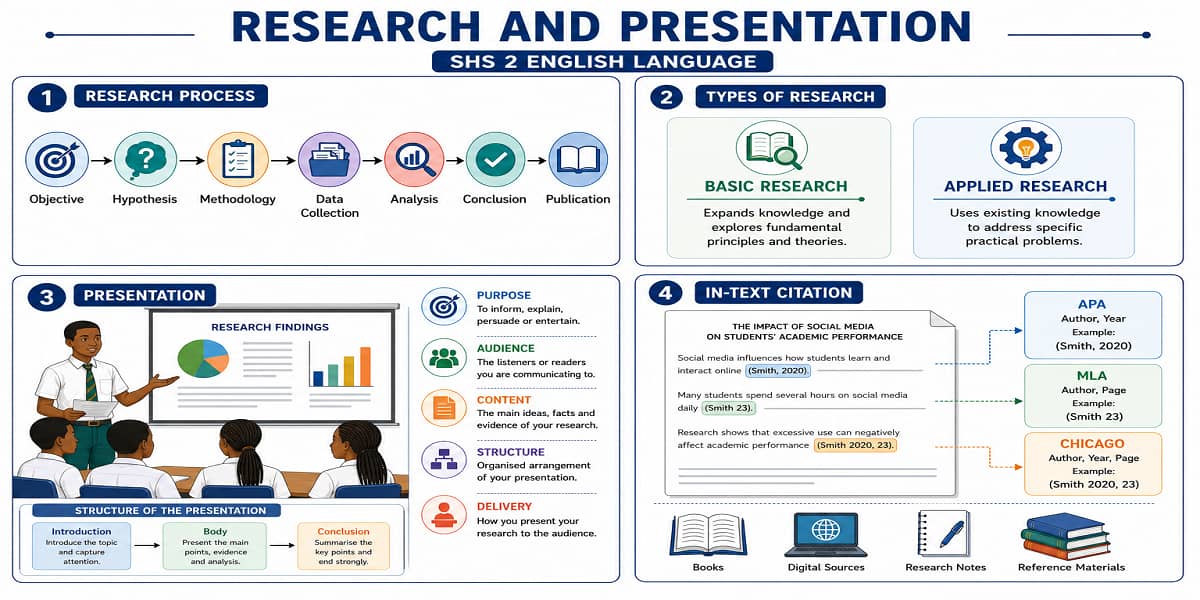
- Objective: A clear statement of what the research aims to achieve or understand.
- Hypothesis: A proposed explanation or prediction that is tested through the research.
- Methodology: The systematic plan for carrying out the research, including methods for collecting and analysing data.
- Data Collection: The process of gathering information from primary sources such as experiments, surveys and observations, or from secondary sources such as books, articles and databases.
- Analysis: The examination and interpretation of data to identify patterns, relationships or trends.
- Conclusion: A summary of the findings that determines whether the hypothesis was supported or refuted.
- Publication: Sharing research results with a wider community through reports, articles, presentations or other means.
Why Research Is Important
- Advances Knowledge: Research contributes to understanding fundamental principles and theories.
- Solves Problems: Research provides solutions to practical issues in different fields.
- Informs Decision-Making: Research provides evidence-based information for policymakers, businesses and individuals.
- Promotes Innovation: Research can lead to new products, technologies and methods.
- Supports Education: Research improves learning and teaching by bringing in new findings and insights.
Check Your Understanding
- What is research?
- What is the difference between basic research and applied research?
- What is the purpose of a research objective?
- What is the role of data collection in research?
- Why is analysis important in research?
Presentation
A presentation is a structured form of communication in which an individual or a group shares information, ideas or arguments with an audience. Presentations are commonly used in education, business and conferences to inform, persuade or entertain.
Key Elements of a Presentation
| Element | What It Means |
|---|---|
| Purpose | The main objective of the presentation, such as informing, persuading or entertaining the audience. |
| Audience | The people listening to the presentation. Their background, needs and expectations should be considered when preparing the presentation. |
| Content | The information or message to be communicated. It should be organised logically and coherently. |
| Structure | The arrangement of the presentation, usually consisting of an introduction, body and conclusion. |
| Delivery | The way the presenter communicates the message, including tone, body language, eye contact and pacing. |
Types of Presentations
- Informative Presentation: Provides information, explains concepts or teaches an audience about a topic.
- Persuasive Presentation: Attempts to convince an audience to accept a particular viewpoint, take an action or change a behaviour.
- Demonstrative Presentation: Shows an audience how to do something through a step-by-step process.
- Inspirational Presentation: Aims to motivate and inspire an audience.
- Business Presentation: Covers matters in a business setting, such as project updates, financial reports, strategic plans and pitches.
- Technical Presentation: Communicates technical information, including complex data, methods or scientific findings.
- Team Presentation: Is delivered by a group in which each member contributes part of the overall message. Coordination and collaboration are important.
Tips for Effective Presentations
- Know Your Audience: Consider the audience’s interests, knowledge level and expectations when preparing both the content and delivery.
- Practise: Rehearse the presentation several times so that you become familiar with the content and improve your delivery.
Research And Presentation Work Together
Research and presentation are closely connected. Good research provides the information needed to create a well-informed, credible and engaging presentation.
The quality and depth of the research can affect how effective the presentation is. When the information has been properly researched, it provides a stronger foundation for communicating the message to the audience.
In-Text Citation
In-text citation is used in academic writing to give credit to the original sources of information, ideas or data. The source is identified within the written work so that the reader can see where the information came from.
APA Style
The APA 7th edition format uses the author’s last name and year of publication.
Format: (Author’s Last Name, Year of Publication)
Example: (Smith, 2020)
For a direct quotation, the page number is also included.
Example: (Smith, 2020, p. 23)
APA: Multiple Authors
- Two authors: (Smith & Jones, 2020)
- Three or more authors: (Smith et al., 2020)
MLA Style
The MLA 8th edition format uses the author’s last name and page number.
Format: (Author’s Last Name Page Number)
Example: (Smith 23)
- Two authors: (Smith and Jones 23)
- Three or more authors: (Smith et al. 23)
Chicago Style
The Chicago 17th edition author-date style uses the author’s last name, year of publication and, where applicable, the page number.
Format: (Author’s Last Name Year of Publication, Page Number)
Example: (Smith 2020, 23)
- Two authors: (Smith and Jones 2020, 23)
- Three or more authors: (Smith, Jones, and Brown 2020, 23)
Applying Research And Presentation Skills
Research becomes more useful when you can organise what you find and communicate it clearly to other people. A good presentation should therefore be based on relevant information, arranged in a clear order and delivered in a way that suits the audience.
Preparing A Presentation
- Choose and understand the topic: Be clear about what you are expected to present.
- Know the audience: Consider the audience’s level of knowledge, interests and expectations.
- Gather relevant information: Use the research process to obtain information from appropriate sources.
- Organise the content: Arrange the information logically so that the audience can follow the ideas easily.
- Prepare the presentation: Decide how the information will be communicated and select suitable supporting materials where necessary.
- Practise: Rehearse the presentation several times to become familiar with the content and improve delivery.
Examples
Example 1
Scenario: A learner investigates a topic, gathers information from books and other sources, examines the information and presents the findings to the class.
Explanation: The learner is using research to obtain and examine information before sharing the findings through a presentation. The research provides the evidence and information needed for the presentation.
Example 2
Scenario: A group is asked to explain a process to their classmates and decides to show the steps in the correct order.
Explanation: This is a demonstrative presentation because its purpose is to show the audience how something is done through a step-by-step process.
Application And Activities
- Work in groups to discuss the meaning and purpose of research.
- Identify the differences between basic research and applied research.
- Choose a suitable topic and identify a clear objective for researching it.
- Discuss the different types of presentations and identify situations in which each type may be appropriate.
- Work in groups to prepare and deliver a presentation on a selected topic.
- Use an appropriate in-text citation style when referring to information, ideas or data obtained from sources.
- Practise presenting your ideas while paying attention to audience, content, structure and delivery.
Practice
- Basic: State the meaning of research and name two types of research.
- Moderate: Explain five key elements of an effective presentation.
- Applied / Discussion: Choose a topic, research it and prepare a short presentation for your classmates. Explain how you would organise the content and adapt your delivery to suit your audience.
Summary
Research is a systematic process of investigating information to establish facts, answer questions, solve problems or develop new theories. Basic research expands knowledge, while applied research focuses on practical problems. Important parts of research include the objective, hypothesis, methodology, data collection, analysis, conclusion and publication.
A presentation is a structured way of communicating information, ideas or arguments to an audience. Effective presentations depend on a clear purpose, knowledge of the audience, well-organised content, suitable structure and good delivery. Presentations may be informative, persuasive, demonstrative, inspirational, business, technical or team presentations.
Research and presentation work together because reliable research provides the information and evidence needed for an effective presentation. In-text citation also helps identify the sources of information, ideas or data used in academic work.
Access NaCCA-aligned Support Packs
Download your structured NaCCA-aligned Teacher Support Pack and Student Learning Pack, designed for clarity, practicality, and reliable teaching and learning.