Consumer Equilibrium and Utility
Consumers have limited income but many wants. Utility helps us understand how consumers allocate their resources to obtain satisfaction.
1. What Is Utility?
Utility is the satisfaction, pleasure or benefit a consumer obtains from consuming goods and services.
A theoretical unit used to express satisfaction is called a util.
Equilibrium means a state of balance. In consumer theory, consumer equilibrium occurs when a consumer has allocated available resources in a way that maximises total satisfaction within the given budget.
2. Consumer Equilibrium
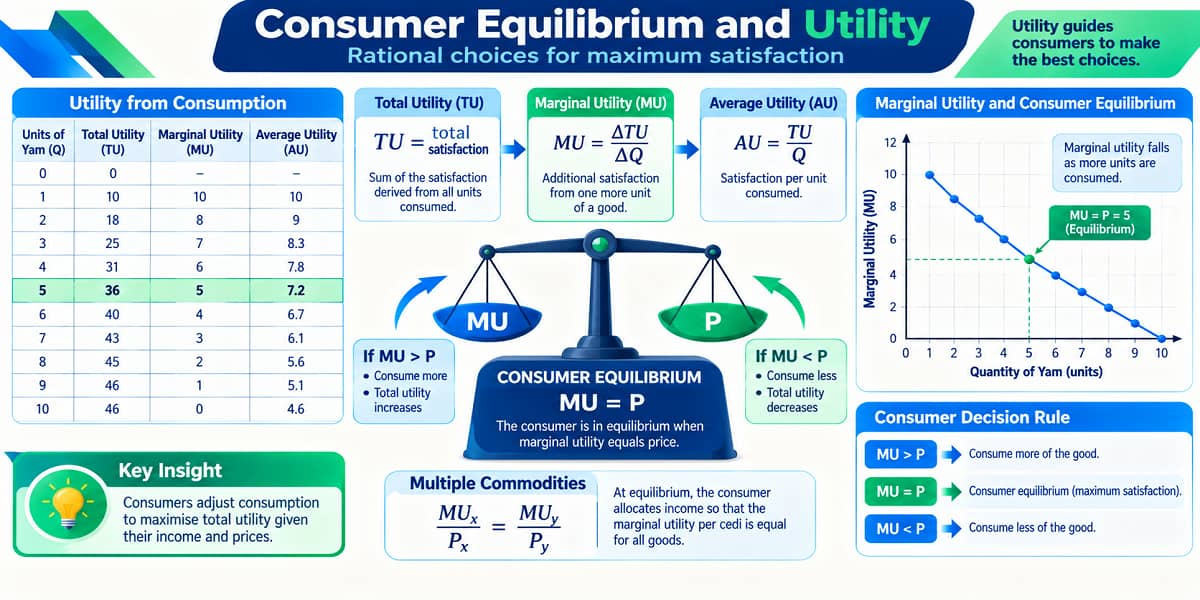
For a single commodity, equilibrium is represented by:
MUx = Px
where MUx is the marginal utility of commodity x and Px is its price.
For several commodities, the principle is expressed as:
MUx/Px = MUy/Py
The idea is that the last unit of money spent on each commodity should provide the same marginal utility.
3. Total Utility
Total Utility (TU) is the total satisfaction obtained from consuming a given quantity of a good or service.
It is the sum of the utility obtained from each unit consumed:
TU = U1 + U2 + U3 + … + Un
For example, suppose a consumer receives the following utility from slices of yam:
| Slice | Utility from the slice | Total Utility |
|---|---|---|
| 1st | 10 | 10 |
| 2nd | 8 | 18 |
| 3rd | 5 | 23 |
| 4th | 2 | 25 |
For four slices:
TU = 10 + 8 + 5 + 2 = 25 utils.
4. Marginal Utility
Marginal Utility (MU) is the additional satisfaction obtained from consuming one more unit of a good or service.
The formula is:
MU = ΔTU / ΔQ
where:
- ΔTU = change in total utility;
- ΔQ = change in quantity consumed.
If total utility changes from 18 to 23 when consumption rises from 2 to 3 slices:
MU = (23 − 18) / (3 − 2)
MU = 5 / 1 = 5 utils.
5. Law of Diminishing Marginal Utility
The law of diminishing marginal utility states that as a person consumes more units of a good, the additional satisfaction from each extra unit tends to decrease.
In the yam example, marginal utility falls from 8 to 5 and then to 2.
6. Average Utility
Average Utility (AU) is the total utility divided by the quantity consumed.
AU = TU / Q
Using the yam example after three slices:
AU = 23 / 3 ≈ 7.67 utils.
7. TU, MU and AU Together
These three concepts answer different questions:
| Concept | Question answered | Formula |
|---|---|---|
| TU | How much total satisfaction is obtained? | Sum of utilities |
| MU | How much extra satisfaction comes from another unit? | ΔTU / ΔQ |
| AU | How much satisfaction is obtained per unit on average? | TU / Q |
8. Complete the Utility Table
Consider the following utility schedule. The price is 5 for each quantity.
| Q | TU | AU | MU | P |
|---|---|---|---|---|
| 1 | 10 | 10.00 | 10 | 5 |
| 2 | 18 | 9.00 | 8 | 5 |
| 3 | 25 | 8.33 | 7 | 5 |
| 4 | 31 | 7.75 | 6 | 5 |
| 5 | 36 | 7.20 | 5 | 5 |
| 6 | 40 | 6.67 | 4 | 5 |
| 7 | 43 | 6.14 | 3 | 5 |
| 8 | 45 | 5.63 | 2 | 5 |
| 9 | 46 | 5.11 | 1 | 5 |
| 10 | 46 | 4.60 | 0 | 5 |
The missing total utilities follow the successive marginal-utility pattern represented by the schedule: TU at Q = 8 is 45, and TU at Q = 10 is 46.
Example Calculation: Q = 8
AU = TU / Q = 45 / 8 = 5.625 ≈ 5.63.
MU = 45 − 43 = 2.
Example Calculation: Q = 10
AU = 46 / 10 = 4.6.
MU = 46 − 46 = 0.
9. Finding Consumer Equilibrium
For a single commodity:
MU = P
From the table, price is 5. At quantity 5, marginal utility is also 5.
MU = 5 and P = 5
Therefore, the consumer equilibrium occurs at Q = 5 units.
10. Practice
Question 1: A consumer obtains 12 utils from the first unit and 7 additional utils from the second unit. Find total utility after two units.
Solution:
TU = 12 + 7 = 19 utils.
Question 2: Total utility rises from 30 to 36 when quantity increases from 4 to 5. Find marginal utility.
Solution:
MU = (36 − 30) / (5 − 4) = 6 utils.
Question 3: If total utility is 40 utils from 8 units, find average utility.
Solution:
AU = 40 / 8 = 5 utils.
Question 4: If the price of a commodity is 4 and marginal utility is 4 at quantity 6, what does this indicate for a single commodity?
Answer: MU = P, so the consumer is at equilibrium at 6 units.
11. Final Synthesis
Total Utility measures total satisfaction. Marginal Utility measures the additional satisfaction from another unit. Average Utility measures satisfaction per unit on average.
The consumer reaches equilibrium for a single commodity when:
MU = P
For several commodities, equilibrium is based on equal marginal utility per cedi:
MUx/Px = MUy/Py
Remember: TU tells the total, MU tells the extra, AU tells the average, and equilibrium identifies the point where the relevant marginal utility condition is satisfied.
Access NaCCA-aligned Support Packs
Download your structured NaCCA-aligned Teacher Support Pack and Student Learning Pack, designed for clarity, practicality, and reliable teaching and learning.