The Subordinate Clause; Cohesive Devices in Paragraph Coherence: Connectors and Transitional Devices; Poetry (Selected Non-African Poem) Poetry Appreciation Explained for SHS 2 English Language (Sem. 1 – Week 2)
Good language use depends on relationships. A sentence becomes more meaningful when its clauses are properly connected. A paragraph becomes easier to follow when its ideas have clear relationships. A poem becomes richer when its language, structure and ideas work together.
That connection runs through three areas of SHS 2 English Language Week 2: subordinate clauses, cohesive devices and poetry appreciation.
Why a Clause Sometimes Needs Another Clause
Consider the expression because I was tired. It contains a subject and a predicate, but it does not communicate a complete sentence by itself. The reader naturally asks: What happened because you were tired?
Place it with an independent clause and the relationship becomes clear:
I went to bed early because I was tired.
The second clause is subordinate because it depends on the main clause. This dependency allows writers to show relationships such as cause, condition, time and contrast.
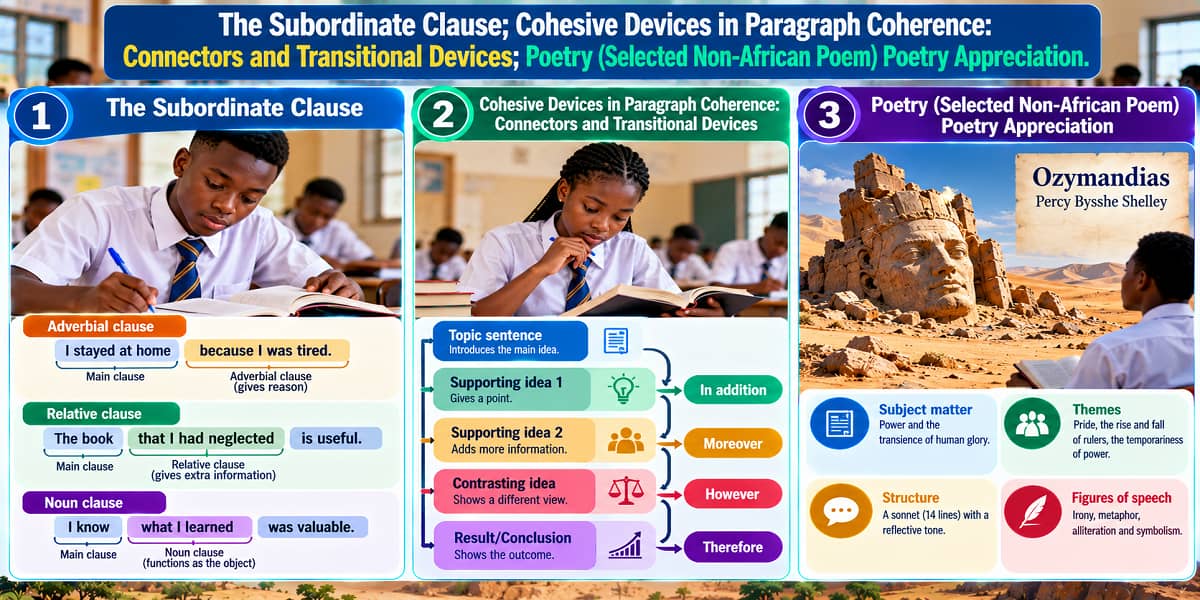
| Subordinate-clause type | Function | Example |
|---|---|---|
| Adverbial | Modifies a verb, adverb or adjective. | Because I was tired, I went to bed. |
| Relative | Qualifies a noun or pronoun. | The chapter that I had neglected was crucial. |
| Noun | Functions as a noun. | What I learned was important. |
Common introductory words include because, since, after, although, unless, until, if, when, whenever, while, whether, where, wherever and before. Dependent words such as what, when, where, why and how can also introduce subordinate clauses.
From Correct Sentences to Coherent Writing
Imagine reading four perfectly grammatical sentences that have no meaningful connection. The sentences may be correct individually, but the paragraph can still be difficult to understand.
This is where coherence matters. A coherent paragraph has unity, cohesion, logical order and clear relationships among its ideas.
One practical way to create this effect is to use cohesive devices. These are words and phrases that help readers see how one idea connects to another. They may also be called linking words, linking expressions, connectors or discourse markers.
Connectors reveal relationships
| Purpose | Examples from the week’s material | Effect |
|---|---|---|
| Contrast | however | Signals a difference or opposing idea. |
| Addition | in addition, besides, moreover, furthermore | Adds another related point. |
| Result | therefore | Shows a consequence or conclusion. |
Consider: The road was flooded. Therefore, the students arrived late. The connector makes the relationship between the two statements explicit.
The Shape of a Coherent Paragraph
A useful paragraph begins with a clear central idea and then develops that idea. Key words can be repeated where necessary, pronouns can refer back to previously mentioned information, and a consistent verb tense can prevent confusion.
For example:
Education provides knowledge and skills. In addition, it develops learners’ ability to reason and solve problems. Furthermore, it can prepare people to participate meaningfully in society. Therefore, education is important for individual and social development.
The connectors do not create the argument by themselves. Instead, they help the reader see the relationships among the ideas.
Reading a Poem as a Whole
Poetry appreciation uses a similar principle of connected interpretation. Rather than identifying literary devices mechanically, the reader asks how the different elements contribute to the poem’s meaning.
The week’s selected poem is Percy Bysshe Shelley’s Ozymandias, a sonnet about the impermanence of human achievements and the passage of time.
The ruined statue
The poem presents a traveller’s account of a broken statue in a desert. Its “trunkless legs of stone” and “shattered visage” suggest the remains of something that was once powerful and imposing.
Then comes the proud inscription:
“My name is Ozymandias, king of kings:
Look on my Works, ye Mighty, and despair!”
The statement is immediately placed against the reality that “Nothing beside remains.” The contrast is central to the poem’s meaning.
Four Windows into Ozymandias
| Element | What it reveals |
|---|---|
| Subject matter | The remains of a once-powerful ruler and the contrast between his pride and the destruction surrounding his statue. |
| Theme | The transience of human achievements and the inevitable decline of earthly power and glory. |
| Structure | A fourteen-line sonnet with an octet and sestet, using iambic pentameter and the stated rhyme scheme ABABACDCEDEFEF. |
| Figures of speech | Irony, metaphor, alliteration and symbolism reinforce the poem’s message. |
The irony is particularly striking. Ozymandias presents himself as a ruler whose achievements should make other powerful people despair. Yet the surrounding landscape shows that his own power has not survived.
The broken statue therefore becomes more than an object. It functions as a metaphor and symbol for the decline of human power and the passage of time. The phrase “sneer of cold command” also uses alliteration to reinforce the image of an arrogant and imperious ruler.
What Poetry Appreciation Requires
A useful appreciation does not merely list devices. It explains their contribution to meaning.
- Identify the subject matter.
- Explain the important themes.
- Examine the poem’s structure.
- Identify relevant figures of speech.
- Explain how these elements work together.
This approach turns poetry from a search for isolated literary terms into an exercise in interpretation.
One Principle Across Grammar, Writing and Literature
There is a useful connection between the three areas studied this week. In grammar, a subordinate clause depends on another clause. In writing, cohesive devices show relationships between ideas. In poetry, individual images, structures and figures of speech contribute to a larger meaning.
In each case, language becomes clearer when relationships are recognised.
A skilled English Language learner therefore asks more than “What is this?” The learner also asks: “What does it do, what does it connect to, and how does that relationship affect meaning?”
Take the Skill Beyond the Classroom
When writing an essay, use connectors deliberately rather than inserting them randomly. When reading, notice how clauses and transitions guide your understanding. When studying poetry, look at how language, structure and imagery cooperate to create an overall effect.
These are transferable skills: they help you write with greater coherence, read with greater attention and interpret literature with greater depth.
Access NaCCA-aligned Support Packs
Download your structured NaCCA-aligned Teacher Support Pack and Student Learning Pack, designed for clarity, practicality, and reliable teaching and learning.