Triphthongs in English Speech Sounds; Reading Comprehension Question Types; Subordinate Clause Explained for SHS 2 English Language (Sem. 1 – Week 3)
English becomes more precise when we learn to notice what happens beneath the surface. A sound can glide through three vowel positions within one syllable. A comprehension question can demand recall, inference or evaluation. A whole clause can function as a noun inside a sentence.
These are three different language phenomena, but they share one principle: good communication requires attention to structure and meaning.
The Three-Sound Glide
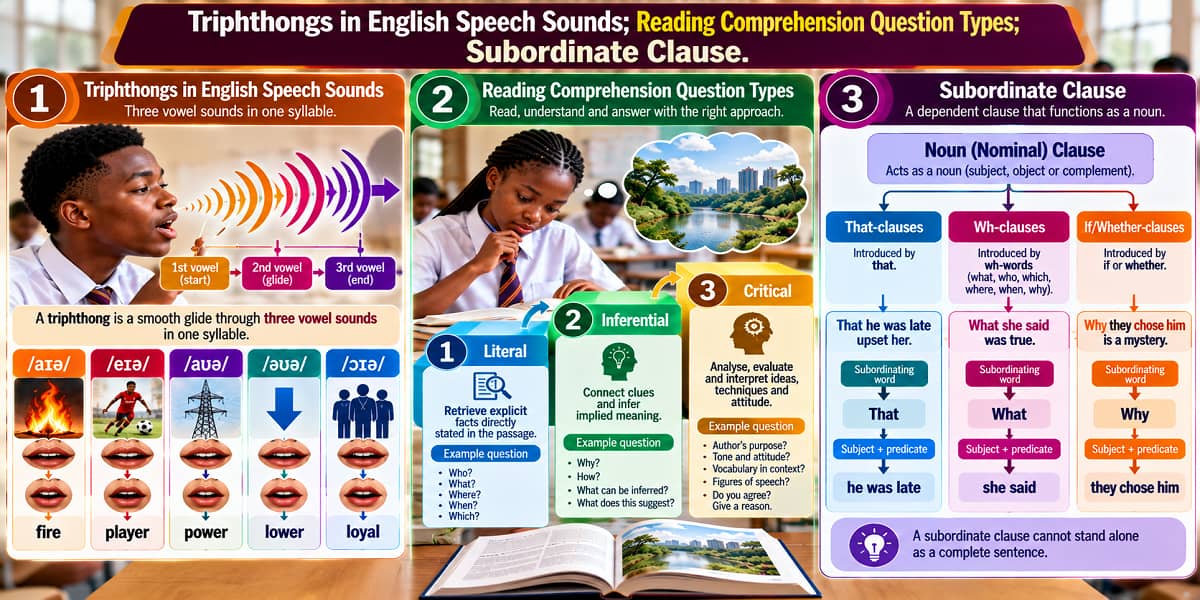
A triphthong is a combination of three vowel sounds produced in a single syllable. The sounds move gradually from the first through the second to the third. This distinguishes triphthongs from diphthongs, which involve two vowel sounds.
| Sound | Examples |
|---|---|
| /aɪə/ | fire, flyer, tire, liar, tyre |
| /eɪə/ | player, mayor, sayer, layer, buyer |
| /aʋə/ | hour, flour, power, flower, tower |
| /ǝʋə/ | lower, slower, widower, mower |
| /ɔɪə/ | lawyer, royal, loyal |
The important feature is not simply the spelling of the word. It is the smooth transition among three vowel-based sounds within one syllable. The material also notes that triphthongs are often found in unstressed syllables and can be represented using the International Phonetic Alphabet.
That makes oral practice valuable. Words such as loyalty, liar, fire, buyer, player, sailor, traveller and historian can be used in meaningful sentences while attention is paid to their vowel movement.
Not Every Comprehension Question Asks for the Same Thing
One reason learners sometimes struggle with comprehension is that they treat every question as though it requires the same method. It does not.
There is an important difference between finding information, drawing a conclusion and evaluating an idea.
| Level | Central task | Typical demand |
|---|---|---|
| Literal | Retrieve | Find information explicitly stated in the passage. |
| Inferential | Connect | Use clues to reach a conclusion that is not directly stated. |
| Critical | Analyse and evaluate | Interpret language, examine relationships, assess information or explain the writer’s attitude. |
Literal reading
Suppose a passage says that Mr. Mensah grows maize and beans, eats fufu and soup after working, listens to birds and then returns to his fields. Questions asking for those details are literal because the information is explicitly present.
Inferential reading
An inferential question requires the reader to connect information. If a passage links sedentary lifestyles and poor eating habits with diseases, a question about the likely consequences of those habits requires a conclusion based on the information rather than a copied sentence.
Critical reading
Critical questions move further. They can involve vocabulary, figures of speech, literary interpretation and attitude. A reader may need to assess the relevance or credibility of information, break ideas into parts, combine perspectives, or explain significance from contextual evidence.
For example, in the environmental passage describing rivers as “once-pristine”, the reader may be asked to explain the word’s meaning, interpret the writer’s attitude or identify what the writer implies should happen.
The Clause That Behaves Like a Noun
A noun clause, or nominal clause, is a dependent clause that performs the work of a noun. It contains a subject and predicate and is commonly introduced by words such as that, what, which, who, whom, whose, why and how.
Consider:
What she said was true.
The words what she said form a complete dependent clause, but within the larger sentence the whole clause occupies a noun-like position.
The same principle appears in:
- The fact is that he upset her.
- Why he was fired was his poor performance.
- I don’t know where she went.
- She asked whether he was coming.
Three Common Forms
| Form | Example | What to notice |
|---|---|---|
| That-clause | She believes that he is honest. | That introduces the clause; it can sometimes be omitted. |
| Wh-clause | I don’t know where she went. | Begins with a wh-word. |
| If/whether clause | She asked whether he was coming. | Can express uncertainty or a condition. |
One Week, Three Forms of Attention
Triphthongs teach attention to sound movement. Comprehension question types teach attention to levels of meaning. Noun clauses teach attention to grammatical function.
That combination is useful well beyond an English classroom. A speaker who controls sound is easier to understand. A reader who distinguishes literal, inferential and critical questions is better equipped to interpret information. A writer who understands clause functions has greater control over sentence construction.
A Practical Habit for Learners
When you encounter an unfamiliar language task, pause before answering and ask three questions:
- What exactly am I hearing or reading?
- What relationship or meaning is being communicated?
- What evidence in the language supports my answer?
Those questions encourage careful pronunciation, purposeful reading and grammatical awareness.
Access NaCCA-aligned Support Packs
Download your structured NaCCA-aligned Teacher Support Pack and Student Learning Pack, designed for clarity, practicality, and reliable teaching and learning.