Triphthongs in English Speech Sounds; Reading Comprehension Question Types; Subordinate Clause
This week develops three connected language abilities: pronouncing triphthongs in connected speech, responding to different levels of comprehension questions, and using noun clauses for communication. The common skill is moving beyond recognition to accurate use and interpretation.
1. Triphthongs in English Speech Sounds
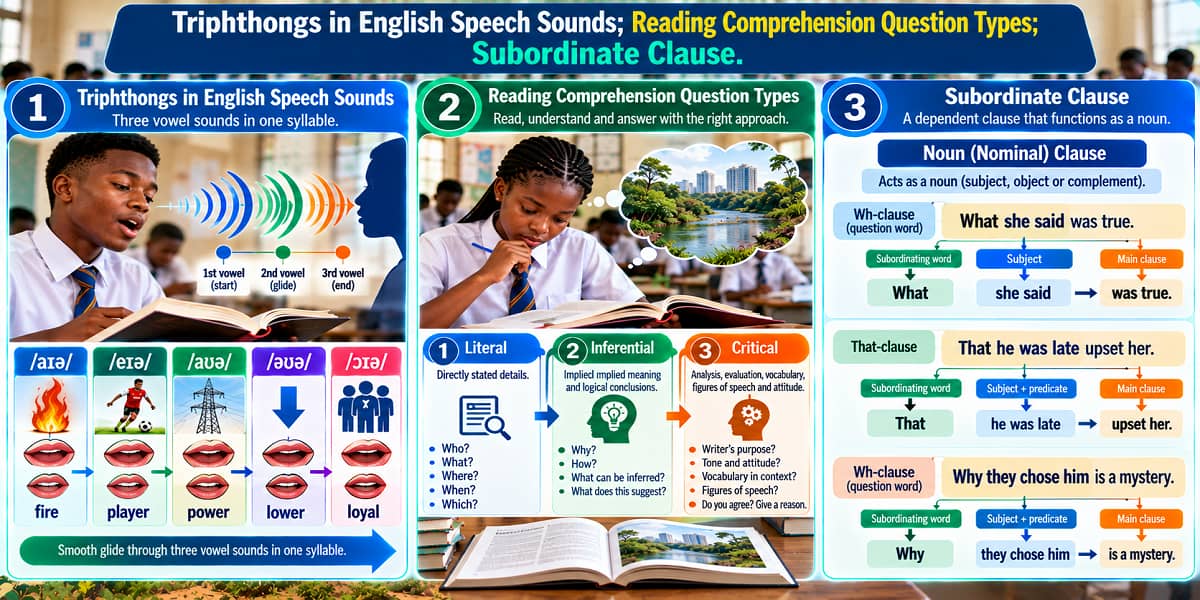
A triphthong is a combination of three vowel sounds produced in a single syllable. The first vowel gradually changes into the second and then the third. Unlike a diphthong, which involves two vowel sounds, a triphthong involves three sounds that glide smoothly together within one syllable.
| Triphthong | Examples |
|---|---|
| /aɪə/ | fire, flyer, tire, liar, tyre |
| /eɪə/ | player, mayor, sayer, layer, buyer |
| /aʋə/ | hour, flour, power, flower, tower |
| /ǝʋə/ | lower, slower, widower, mower |
| /ɔɪə/ | lawyer, royal, loyal |
The material also gives common examples such as /aʊə/ in hour and /aɪə/ in fire, represented as /aʊ.ər/ and /faɪ.ər/ respectively.
How to recognise a triphthong
- Three vowel-based sounds: the sound moves through three vowel sounds.
- One syllable: the three sounds occur within one syllable.
- Smooth transition: the sounds glide continuously into one another.
- IPA representation: the individual vowel sounds can be represented using the International Phonetic Alphabet.
Listen for the movement rather than pronouncing the three sounds as three separate syllables.
Practise the sound in context
Use triphthong-containing words in meaningful sentences:
- Loyalty is a virtue.
- It is bad to be a liar.
- The fire burned fiercely in the hearth.
- The buyer carefully examined the merchandise.
- The player skilfully navigated the video game’s higher levels.
Quick check: Which words in this list contain triphthongs: power, sage, layer, sparrow, major, soldier?
Answer: power and layer.
2. Reading Comprehension Question Types
Comprehension questions test a reader’s understanding of a passage, article or larger literary text. They differ in complexity because not every question asks the reader to perform the same kind of thinking.
The three major types in this week’s material are literal, inferential and critical-level questions.
| Question type | What the reader does | Evidence needed |
|---|---|---|
| Literal / contextual | Recalls specific details directly stated in the text. | Explicit information. |
| Inferential | Makes logical inferences and draws conclusions. | Information implied by the text. |
| Critical-level | Analyses, evaluates and interprets information. | Textual evidence, context and reasoning. |
Literal questions: Find what is stated
A literal question asks for information that the passage states directly.
For example, in a passage about Mr. Mensah, a Ghanaian farmer who grows maize and beans, questions such as “What is the farmer’s name?” or “What types of crops did he grow?” are literal questions.
Strategy: locate the relevant sentence or detail in the passage and answer directly.
Inferential questions: Work out what is implied
An inferential question does not necessarily have its answer written in exactly the same words as the question. You must combine clues from the passage and draw a logical conclusion.
For example, if a passage says that sedentary lifestyles and poor eating habits contribute to diseases such as diabetes, hypertension and obesity, you may be asked what the likely consequence of such habits is. The answer requires you to connect the information rather than simply copy one sentence.
Strategy: identify the clues, connect them, and draw a conclusion supported by the text.
Critical-level questions: Think beyond recall
Critical-level questions require analysis, evaluation and interpretation. They can focus on figures of speech, vocabulary, literary issues and the writer’s attitude.
For example, consider:
The earth is a fragile planet, and our reckless activities are piercing its lungs, suffocating its breath, and draining its lifeblood. The once-pristine rivers are now choked with plastic waste, and the skies are shrouded in a thick haze of pollution.
A critical question could ask about the meaning of “pristine”, the writer’s attitude towards the environment, or what the writer implies should be done.
Strategy: identify the relevant language or idea, interpret it in context, and support your response with evidence from the passage.
3. Match the Question to the Thinking Required
| If the question asks you to… | Think at this level |
|---|---|
| Recall a name, place, event, fact or stated detail. | Literal |
| Explain what can logically be concluded from clues. | Inferential |
| Interpret vocabulary or figurative language in context. | Critical |
| Evaluate the writer’s attitude or argument. | Critical |
| Explain an implied relationship or significance. | Inferential or critical, depending on the demand of the question. |
4. Subordinate Clause: Noun or Nominal Clause
A nominal clause, also called a noun clause, is a dependent clause that functions as a noun in a sentence. It contains a subject and a predicate and commonly begins with a subordinating conjunction or relative pronoun.
Examples:
- What she said was true.
- The fact is that he upset her.
- Why he was fired was his poor performance.
Parts of a noun clause
| Component | Role | Example |
|---|---|---|
| Subordinating conjunction or relative pronoun | Introduces the noun clause. | what, that, why |
| Subject | The noun or pronoun performing the action. | she in “What she said” |
| Predicate | Tells something about the subject and contains the verb. | said in “What she said” |
The basic structure can therefore be represented as:
subordinating conjunction or relative pronoun + subject + verb
Three forms of noun clause
- That-clause: She believes that he is honest. The word that may sometimes be omitted: She believes he is honest.
- Wh-clause: begins with a wh-word such as what, when, where, why, how, who, whom or which. Example: I don’t know where she went.
- If/whether clause: often expresses uncertainty or a condition. Example: I wonder if it will rain tomorrow.
5. Identify the Noun Clause
Look at each sentence and identify the noun clause:
- What she said was true.
Answer: What she said. - That he was late upset her.
Answer: That he was late. - Why they chose him is a mystery.
Answer: Why they chose him.
Notice that each highlighted group contains a subject and a verb, but the entire group functions as a noun within the larger sentence.
6. Bringing the Skills Together
The three focal areas reinforce careful language use. Triphthongs require you to notice how sounds move within a syllable. Comprehension questions require you to notice how information is presented and how meaning can be inferred. Noun clauses require you to notice how a whole dependent clause can function as a noun.
In each case, close attention to structure leads to better communication.
7. Final Practice
- Define a triphthong.
A combination of three vowel sounds produced in a single syllable, with the first sound gradually changing into the second and then the third. - State the three main comprehension question types.
Literal, inferential and critical-level questions. - What is the main difference between literal and inferential questions?
A literal question asks for information directly stated in the text, while an inferential question requires the reader to draw a logical conclusion from information that is implied. - What is a noun clause?
A dependent clause that functions as a noun in a sentence. - Identify the noun clause in “I wonder if it will rain tomorrow.”
If it will rain tomorrow.
8. Synthesis
Triphthongs are three vowel sounds that glide together within one syllable. Comprehension questions may test direct recall, inference, or critical analysis. A noun clause is a dependent clause that functions as a noun and may begin with words such as that, what, who, why or how.
Listen carefully, read purposefully and analyse structure. These three habits will strengthen both your spoken and written English.
Access NaCCA-aligned Support Packs
Download your structured NaCCA-aligned Teacher Support Pack and Student Learning Pack, designed for clarity, practicality, and reliable teaching and learning.