Oral Communication, Summary Writing and Subject–Verb Agreement Explained for SHS 2 English Language (Sem. 1 – Week 11)
Three Everyday Skills Behind Effective Communication
People communicate for many reasons. A school leader may announce a change, a friend may share an emotional experience, a student may persuade classmates to support an idea, and a reader may need to explain a long passage in a few sentences. These situations seem different, but each requires an understanding of purpose and meaning.
Effective communication also depends on accuracy. A speaker must select words that suit the situation, a reader must distinguish essential information from minor details, and a writer must construct sentences correctly. Three English Language skills help develop these abilities: recognising the purpose of oral communication, summarising texts and using subject–verb agreement accurately.
Oral Communication: Why Do People Speak?
Oral communication is the sharing of information, ideas or messages through spoken language. It occurs in formal and informal situations, and its purpose influences the speaker’s choice of words and manner of expression. The same person may speak to inform an audience in one situation, express emotion in another and persuade someone in a third.
Understanding purpose is therefore an important listening skill. A listener should not simply hear the words; the listener should consider what the speaker intends to achieve and what response is expected.
Thirteen purposes of communication
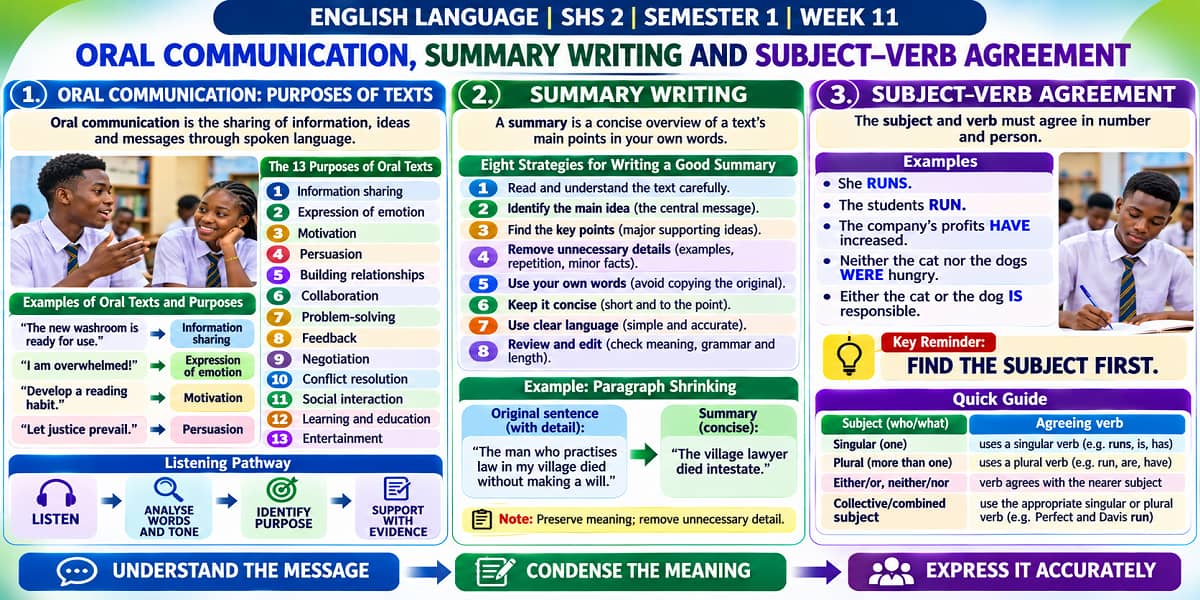
Communication serves many purposes. It can share information, express emotion, motivate, persuade, build relationships, support collaboration, solve problems, provide feedback, negotiate agreements, resolve conflict, encourage social interaction, support learning and provide entertainment.
These purposes are related, but they are not interchangeable. Information sharing provides facts or messages. Expression of emotion makes feelings known. Motivation encourages action, while persuasion attempts to influence attitudes, beliefs or decisions. Collaboration brings people together to achieve a common goal; negotiation seeks an agreement or compromise; and conflict resolution addresses disputes. Feedback exchanges opinions and suggestions, while social interaction supports everyday conversation and connection.
For example, a school announcement that a new washroom beside L-Block is ready for use primarily shares information. A learner who says, “I am overwhelmed. This is stunning!” is expressing emotion. A speaker who urges a jury to let justice prevail is attempting to persuade. A person who tells learners to develop a reading habit because another learner has achieved success is motivating them.
Listening for intention
To identify the purpose of an oral message, listen to the whole communication. Notice the main idea, the words used, the speaker’s tone and the response the speaker appears to seek. Then state the most important purpose and support the answer with evidence. A message may have secondary effects: a company announcement can also encourage confidence, for example. However, the listener should identify the purpose that is most prominent.
Consider a company representative who explains the history of a business, describes its growth from a small fabric and sewing shop to eighteen branches, and announces plans for further expansion. The main purpose is information sharing because the speaker is giving an account of the company’s development and future plans. By contrast, a person who reacts to an unexpected celebration with excitement is primarily expressing emotion. A speaker who presents evidence to convince a jury is persuading, while a speaker who uses an award winner’s experience to encourage others to read is motivating.
This ability is useful in daily life. Listening carefully helps people distinguish an announcement from an instruction, an argument from an emotional reaction, and a friendly conversation from a negotiation. It can also prevent misunderstandings because listeners become more aware of what the speaker is trying to accomplish.
Summary Writing: Finding the Essential Message
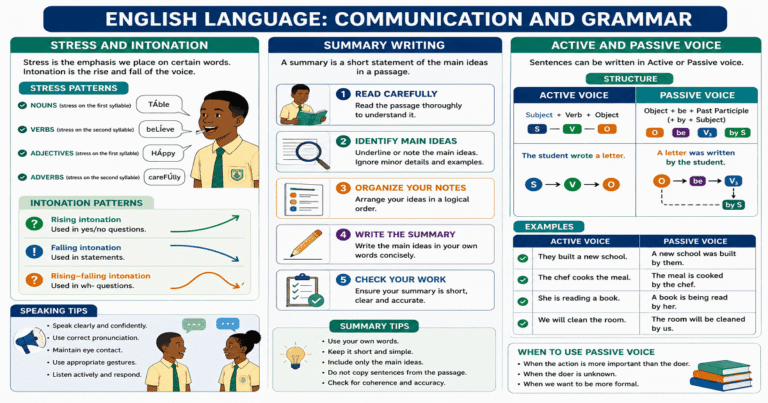
Modern life exposes people to lengthy passages, reports, explanations and conversations. It is not always practical to repeat every detail. Summary writing helps readers condense information while preserving its essential meaning. A summary is a concise overview of a text’s main points, written in the summariser’s own words as far as possible.
Good summarising requires understanding before shortening. A reader who removes words without understanding the passage may destroy its meaning. The first task is to identify what the text is mainly saying. The next is to decide which supporting points are necessary to communicate that central idea.
Eight strategies for a useful summary
- Read and understand: Read the passage carefully before writing. Establish its overall meaning.
- Identify the main idea: Determine the central message or thesis.
- Select key points: Keep the important supporting ideas that develop the main message.
- Remove unnecessary details: Leave out minor examples, repetition, modifiers, adverbials, appositives and other details that do not contribute to the essential meaning.
- Use your own words: Paraphrase the main ideas rather than copying whole sentences.
- Be concise: Aim for a summary that is about 10% or less of the original text’s length, while preserving its essential meaning.
- Use clear language: Avoid unnecessarily complex vocabulary or jargon.
- Review and edit: Check that the summary is accurate, clear and free from unnecessary repetition.
Paragraph shrinking in practice
Paragraph shrinking means reducing a paragraph to its most important information. It is not simply deleting words. It involves identifying the central idea, selecting the necessary supporting points and removing details that do not change the message. One useful technique is to replace a long expression with a shorter word where the meaning remains accurate.
For example, “the man who practises law” can be shortened to “the lawyer”. “The constant inability to sleep at night” can be expressed as “insomnia”. “The act of spacing out births” can be expressed as “birth spacing”. These shorter expressions help reduce wordiness without changing the intended meaning.
Consider the sentence: “The man who practises law in my village died without making a will.” A concise summary is: The village lawyer died intestate. The word intestate communicates the idea that the person died without making a will. The sentence has been shortened while retaining its essential information.
Another example is: “This morning, while the early morning cars were tooting their horns, the birds singing their hallelujah chorus to the Lord and the sun glittering with glorious brightness, Bediako knocked on my door.” The central event is that Bediako knocked. A concise summary is: Bediako knocked on my door this morning. The descriptions of cars, birds and sunlight create atmosphere, but they are not necessary to communicate the main event.
Why summarising matters
Summary writing saves time because readers can access essential information without repeating an entire text. It improves clarity by making complex material easier to understand. The process of selecting and restating key ideas can support retention. Summaries also facilitate communication, help teachers and employers assess understanding, support research by making it easier to review and compare texts, and assist decision-making by presenting important information concisely.
These benefits make summarising useful well beyond English lessons. Learners can use it when reviewing notes, reading explanations in other subjects or preparing a concise account of information. In professional situations, people may need to summarise a meeting, report or discussion so that others can understand the main points quickly.
Subject–Verb Agreement: Accuracy in Everyday Language
Subject–verb agreement, also called concord, means that the verb agrees with its subject in number and person. A singular subject generally takes a singular verb, while a plural subject generally takes a plural verb. Compare She runs to the store with The students run to the store. The subject determines the form of the verb.
Agreement errors can occur when speakers choose a verb based on a nearby noun rather than the actual subject. In The teams of players are practising hard, the subject is teams, not players. In The company’s profits have increased, the subject is profits, which is plural. Identifying the subject first helps prevent these errors.
Sentences with either…or and neither…nor require particular attention. In the patterns practised here, the verb agrees with the subject nearest to it. Thus, Neither the cat nor the dogs were hungry uses were because dogs is the nearer plural subject. Either the cat or the dog is responsible uses is because dog is the nearer singular subject.
Common errors and their corrections
| Incorrect | Correct |
|---|---|
| She run to the store. | She runs to the store. |
| The students was excited. | The students were excited. |
| Most students prefers online learning. | Most students prefer online learning. |
| The company’s profits has increased. | The company’s profits have increased. |
| Neither the teacher nor the students was aware. | Neither the teacher nor the students were aware. |
Collective nouns also require attention to the intended subject. In the sentence The herd of deer was grazing in the meadow, herd is treated as a singular collective subject. The verb is therefore was. The important habit is to locate the main subject and understand how it is being used in the sentence.
How the Three Skills Support One Another
Oral communication, summarising and concord are connected through the way people understand and express ideas. Listening for purpose helps a person recognise what a speaker wants to achieve. Summary writing helps the listener or reader preserve the central message without unnecessary detail. Subject–verb agreement ensures that the ideas expressed in the resulting sentences are grammatically accurate.
Imagine listening to a school announcement. First, identify whether the speaker is informing, motivating or requesting action. Next, write a short summary containing the essential message. Finally, check the verbs in your summary to ensure that they agree with their subjects. This activity brings listening, reading, writing and grammar together in a practical way.
Reflection Questions
- What is the main purpose of a message that urges a jury to let justice prevail?
Persuasion, because the speaker is trying to influence the jury’s decision. - What is paragraph shrinking?
Reducing a paragraph to its essential information while preserving its meaning. - Why should a summary be written in your own words?
To demonstrate understanding and communicate the main ideas without relying on direct copying. - Correct: “The teams of players is practising hard.”
The teams of players are practising hard. - Why is “Bediako knocked on my door this morning” an appropriate summary of the longer sentence about the cars, birds and sunlight?
It preserves the main event and removes descriptive details that are not essential to that event.
Conclusion: Communicate with Purpose and Precision
Recognising the purpose of oral communication helps listeners understand why a message is being delivered and how they should respond. Summary writing develops the ability to select essential information, express it concisely and preserve its meaning. Subject–verb agreement supports grammatical accuracy in speech and writing. Together, these skills help learners communicate with greater understanding, clarity and confidence in school and everyday life.
Access NaCCA-aligned Support Packs
Download your structured NaCCA-aligned Teacher Support Pack and Student Learning Pack, designed for clarity, practicality, and reliable teaching and learning.