How Playwrights Develop Tragedy, Tragicomedy and Melodrama in Dramatic Texts – SHS 2 Literature-in-English (Sem. 1 – Week 10)
Beyond the Name of a Play: Understanding How Drama Is Developed
Why does one dramatic performance leave an audience reflecting on human suffering, while another produces laughter in the middle of a serious situation? Why do some plays create intense emotional reactions through exaggerated characters and dramatic confrontations?
The answers lie in how playwrights construct their stories. A dramatic work is not defined only by its title or the events it presents. Its form develops through the interaction of themes, characters, conflicts, dialogue, language and tone.
These elements influence how audiences interpret a play and respond to its characters. They also help establish whether a dramatic work is developed as a tragedy, tragicomedy, melodrama or comedy.
For readers and students of literature, recognising these elements is an important step towards understanding drama. Rather than simply naming a dramatic form, the reader must be able to explain how the playwright creates it.
1. Drama Is More Than Written Dialogue
Drama is a form of literary composition designed for performance. Actors take the roles of characters, perform indicated actions and speak the written dialogue.
This means that a dramatic text communicates through several connected elements.
Characters
Characters provide the human experiences through which the story develops. Their personalities, decisions, weaknesses and relationships influence the events of the play.
Actions
Actions show how characters respond to situations and how conflicts develop. They help move the dramatic story towards its eventual outcome.
Dialogue
Dialogue communicates the words exchanged between characters. It provides information about their thoughts, relationships, intentions and experiences.
However, these elements do not operate independently. The way characters speak, behave and respond to conflicts contributes to the overall tone and meaning of the performance.
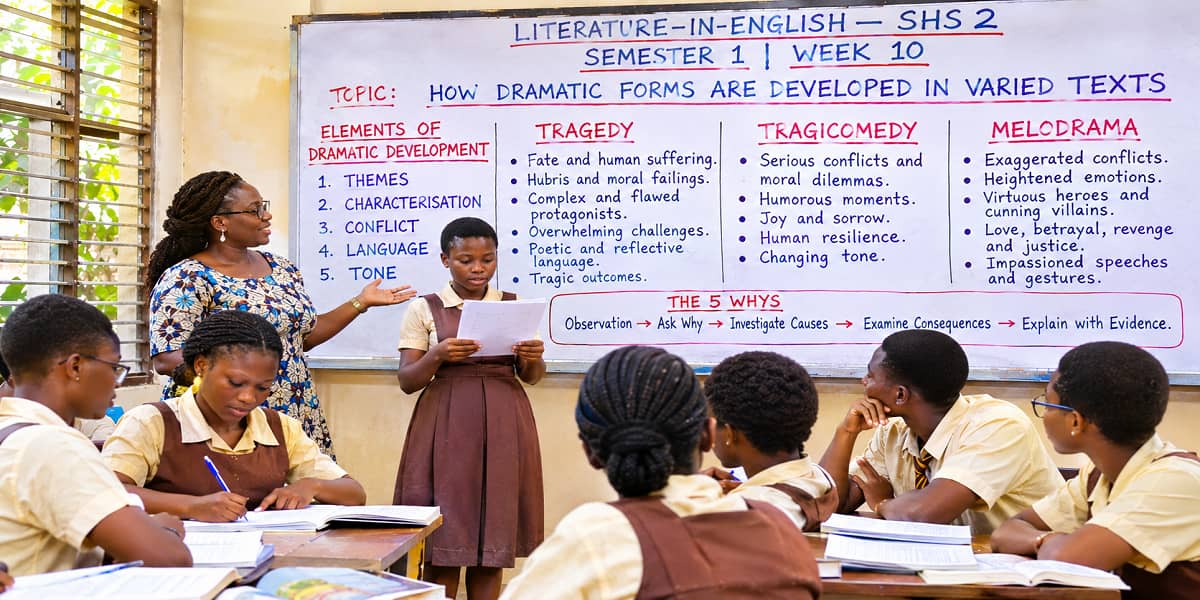
2. The Building Blocks of Dramatic Development
Before identifying the characteristics of individual dramatic forms, it is useful to understand the elements that contribute to their development.
Themes and Ideas
Themes are the important ideas explored in a dramatic work. They provide the intellectual and emotional direction of the story. A play exploring fate and human suffering, for example, develops a different experience from one examining betrayal, revenge and justice.
Characterisation
Characterisation determines how individuals are presented and developed. Complex and flawed protagonists can contribute to tragic storytelling, while contrasting heroes and villains are important in melodrama.
Conflict
Conflict creates the struggles that influence the development of events. The nature of these struggles helps determine the dramatic experience. Serious conflicts may lead to tragic consequences, while conflicts accompanied by humour can contribute to tragicomedy.
Language
Language helps communicate the seriousness, emotional intensity and meaning of a play. Poetic and reflective expressions may deepen tragedy, while passionate speeches and exaggerated gestures strengthen melodramatic presentations.
Tone
Tone describes the overall emotional character of the work. A play may maintain a serious atmosphere, move between seriousness and humour, or present highly intensified emotional experiences.
Outcomes
The consequences of the characters’ decisions contribute to the final direction of the story. These outcomes reinforce the dramatic form by demonstrating how conflicts and character weaknesses affect the narrative.
3. Tragedy: Developing Stories Through Fate and Human Suffering
Tragedy is developed through serious themes, complex characters and overwhelming challenges that lead towards downfall or catastrophic outcomes.
Its significance extends beyond presenting unfortunate events. Tragedy explores the relationship between human weaknesses, decisions, circumstances and suffering.
Fate and Human Suffering
Fate and suffering are important themes in tragedy. The experiences of the protagonists may reveal how circumstances and events influence their lives. Human suffering provides the emotional foundation through which audiences encounter the seriousness of the story.
Hubris and Moral Failings
Hubris refers to excessive pride or overconfidence. Moral failings involve weaknesses in judgement or conduct. These features can influence decisions and contribute to the development of tragic events.
Complex and Flawed Characters
Tragic protagonists are often complex individuals with both admirable qualities and significant weaknesses. Their personalities contribute to the development of the plot and make their experiences important to the audience.
Overwhelming Challenges
The protagonists face difficulties that lead towards downfall or catastrophic outcomes. The progression of these challenges creates the serious direction associated with tragedy.
Poetic and Reflective Language
Tragedy frequently uses poetic and reflective language to deepen emotional experiences and communicate profound issues. Language therefore becomes an important means of strengthening the audience’s understanding of the narrative.
These elements work together to create a dramatic experience in which character weaknesses, serious conflicts and unfortunate outcomes become closely connected.
4. Tragicomedy: Reflecting the Contradictions of Human Experience
Human experiences are not always entirely joyful or entirely sorrowful. Difficult circumstances may exist alongside moments of humour, and serious conflicts may be accompanied by light-hearted observations.
Tragicomedy explores this combination by blending elements of tragedy and comedy.
Serious Conflicts and Moral Dilemmas
Tragicomedies may present serious struggles and difficult decisions. Characters may face competing considerations that create uncertainty and complexity.
Humour Within Serious Situations
Humorous moments and light-hearted observations may appear alongside serious developments. This combination produces contrasts in the dramatic experience.
Fate, Joy and Sorrow
Themes of unpredictable fate and the coexistence of joy and sorrow help tragicomedy explore the changing nature of human experiences.
Human Resilience
Characters may experience personal growth while dealing with adversity. Their responses reveal the ability to continue and develop despite difficult circumstances.
Changing Tone
The tone shifts between seriousness and comedy. These changes are important because they reflect the dual nature of human experience and influence how audiences respond to the play.
Tragicomedy therefore offers a more complex dramatic experience than a narrative that remains consistently serious or humorous.
5. Melodrama: The Power of Exaggeration and Moral Contrast
Melodrama engages audiences through exaggerated conflicts, heightened emotions and clear moral contrasts between characters.
Its dramatic development depends on the presentation of strong emotional experiences and highly expressive confrontations.
Virtuous Heroes and Cunning Villains
Melodrama often presents characters in contrasting moral positions. Heroes may be portrayed as virtuous, while villains are presented as cunning or morally questionable.
Love, Betrayal, Revenge and Justice
These themes provide opportunities for conflicts and dramatic confrontations. They allow the play to explore relationships, wrongdoing and the desire for justice.
Heightened Emotions
Characters express intense feelings as they respond to difficult circumstances. Their reactions help create the emotional atmosphere associated with melodrama.
Impassioned Speeches and Gestures
Melodrama uses passionate speeches and exaggerated gestures to communicate emotional experiences. These techniques make confrontations more dramatic and may help communicate moral lessons.
Dramatic Confrontations
Conflicts between contrasting characters emphasise moral dilemmas and emotional turmoil. These encounters contribute to the development of the plot and strengthen the audience’s engagement.
Melodrama therefore demonstrates how exaggerated presentation can be used to communicate moral and emotional experiences through performance.
6. How Language Changes the Dramatic Experience
Language is not simply a tool for allowing characters to communicate. It also helps establish the atmosphere and emotional direction of a play.
In tragedy, poetic and reflective language strengthens the seriousness of the issues being explored. It can encourage audiences to reflect on human suffering, fate and moral weaknesses.
In melodrama, passionate speeches and exaggerated gestures intensify emotional confrontations. The presentation may become highly expressive to encourage strong audience responses.
In tragicomedy, the changing tone between seriousness and humour contributes to the contrast that defines the dramatic experience.
Examining language therefore helps readers understand not only what characters communicate but also how their expressions contribute to the development of the dramatic form.
7. Grand Guignol: Exploring the Combination of Dramatic Elements
Grand Guignol provides another opportunity to consider how dramatic elements can be combined.
It is described as a form of drama that mixes components of tragedy, horror and comedy. Its combination of these elements creates a distinctive dramatic experience.
Selected Hitchcock films are identified as possible examples for exploration. Arsenic and Old Lace is also mentioned as a gentler, old-fashioned version of the form.
This discussion illustrates that dramatic storytelling can involve more complicated combinations than a single dominant emotional experience.
It also provides an opportunity to examine how tragedy and comedy may interact within dramatic works.
8. How to Analyse a Dramatic Text Effectively
Recognising a dramatic form requires careful examination of the text. A reader should identify relevant features and explain how they contribute to the classification.
Examine the Themes
Identify the important ideas explored in the work. Consider whether the text focuses on fate, suffering, moral failings, love, betrayal, revenge or justice.
Study the Characters
Examine the personalities, weaknesses, motivations and relationships of the central characters. Consider how these characteristics influence the events.
Identify the Conflicts
Determine the nature of the struggles experienced by the characters. Examine whether they are serious, humorous, emotionally exaggerated or a combination of different experiences.
Examine the Language
Look for poetic expressions, reflective language, passionate speeches and exaggerated gestures. Consider how they influence the presentation.
Consider the Tone
Determine whether the play creates a serious, humorous, mixed or emotionally intense experience. Changes in tone may also provide evidence of how the dramatic form develops.
Support Your Interpretation
Use specific events, character behaviour and expressions from the text to justify your conclusion. A strong interpretation explains the relationship between the evidence and the dramatic form.
9. The 5 Whys: Moving Beyond Simple Classification
One useful method for analysing dramatic works is the 5 Whys strategy. It encourages readers to ask repeated questions about an observation until they develop a deeper explanation.
Consider a text classified as tragedy because its main characters die at the end.
Why does the text qualify as tragedy? Because the main characters die.
Why do they die? Because misunderstandings and family conflicts contribute to the events.
Why do the conflicts become so serious? Because they escalate into violence.
Why is the violence significant? Because it produces irreversible consequences.
Why do these consequences matter? Because they highlight the destructive power of hatred and fate.
This process transforms a simple classification into a reasoned explanation. It helps readers connect the events of a play with its themes and underlying meaning.
10. Learning Through Discussion and Performance
Drama is particularly suitable for collaborative learning because its features can be examined through reading, discussion and performance.
Group analysis of a short excerpt from a tragic text, comedy or tragicomedy allows learners to identify important features and support their interpretations.
Film excerpts provide another opportunity to observe characters, conflicts, expressions and dialogue. Subtitled clips can help learners examine the language used and compare different dramatic experiences.
Think-Pair-Share encourages learners to reflect independently, discuss their observations with a partner and communicate their conclusions to the wider group.
Presentations also provide an opportunity to explain how a dramatic form influences what happens to characters in a story. This develops the ability to communicate literary interpretations clearly and systematically.
Conclusion: Understanding the Craft Behind Dramatic Forms
Different dramatic forms are developed through the interaction of themes, characterisation, conflicts, language, tone and outcomes.
Tragedy uses serious themes, flawed protagonists and poetic language to explore suffering and tragic consequences. Tragicomedy combines serious conflicts with humour and changing emotional experiences. Melodrama uses exaggerated conflicts, heightened emotions and moral contrasts to engage audiences.
Understanding these elements allows readers to move beyond simply naming a dramatic form. It helps them explain how playwrights construct dramatic experiences and how different features contribute to the meaning of a play.
By examining dramatic texts, asking deeper questions and supporting interpretations with evidence, learners can develop stronger analytical and literary appreciation skills.
Access NaCCA-aligned Support Packs
Download your structured NaCCA-aligned Teacher Support Pack and Student Learning Pack, designed for clarity, practicality, and reliable teaching and learning.