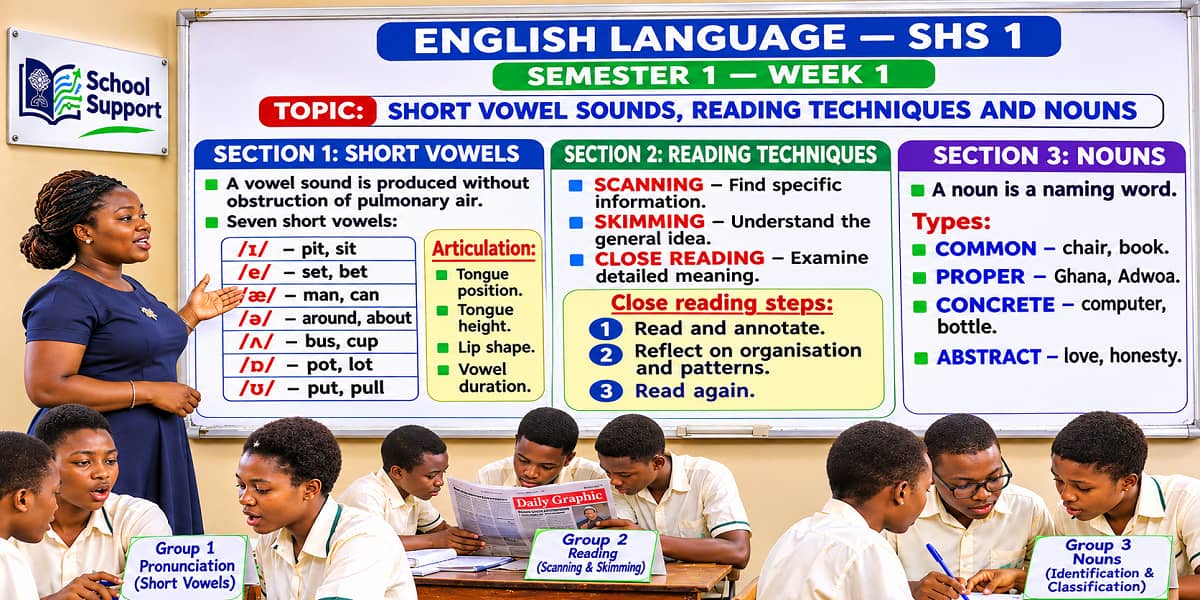
Three Essential English Language Skills Every SHS 1 Learner Should Master (Sem. 1 – Week 1)
Introduction: The Foundation of Effective Communication
Imagine speaking to someone who repeatedly misunderstands your words because of unclear pronunciation. Consider searching through several pages of a newspaper for one particular name. Think about writing a sentence but struggling to identify the correct words for the people, places or ideas you want to describe.
These are everyday communication challenges. They demonstrate why learning English involves more than memorising vocabulary and grammatical rules. Successful communication requires the ability to pronounce words clearly, understand written information and construct meaningful sentences.
For Senior High School learners beginning their English Language studies, three areas provide an important foundation: speech sounds, reading techniques and nouns.
Speech sounds contribute to accurate oral communication. Reading techniques help learners retrieve information and understand texts. Nouns provide the naming vocabulary needed to express ideas about people, places, objects and experiences.
Developing these skills together can improve performance in the classroom and support communication in everyday life, further education and the world of work.
1. Why Accurate Pronunciation Matters
Speaking clearly is an important part of effective communication. A speaker may know exactly what they want to say, but unclear pronunciation can prevent listeners from understanding the intended message.
One important aspect of pronunciation is the production of vowel sounds.
English speech sounds are grouped into vowels and consonants. A vowel sound is produced without obstruction of the pulmonary air coming from the lungs. Pure vowels are also known as monophthongs.
The distinction between a vowel letter and a vowel sound is particularly important. The letters a, e, i, o and u are familiar vowel letters, but their pronunciation changes according to the words in which they occur.
For example, live and leave have different meanings because their vowel sounds differ. The same applies to hit and heat.
This illustrates why learners should pay attention to the sounds they produce rather than relying only on the spelling of a word.
2. Getting to Know the Seven Short Vowels
Pure vowel sounds can be described according to the position of the tongue, the shape of the lips and the length of vocalisation.
The tongue may be positioned towards the front, centre or back of the mouth. Its position relative to the palate may be high, mid or low. The lips may be rounded or unrounded, while vowel duration may be short or long.
These characteristics help explain why different vowel sounds are produced.
There are seven short vowel sounds identified for focused practice in this lesson.
/ɪ/
This sound occurs in words such as pit, sit and fill.
/e/
Examples include set, bet and let.
/æ/
This sound occurs in man, that and can.
/ə/
Examples include around, about and teacher.
/ʌ/
Examples include bus, hut and cup.
/ɒ/
This sound occurs in pot, lot and dross.
/ʊ/
Examples include put, bush and pull.
Short vowels are noticeably shorter than long vowels and are produced with one relatively stable mouth position. Learning to distinguish them improves the accuracy of spoken English.
3. Moving from Individual Sounds to Connected Speech
Pronouncing a vowel correctly in isolation is useful, but communication takes place through words, sentences and conversations.
This means that learners should practise short vowels in connected speech rather than limiting their practice to individual sounds.
One useful exercise involves comparing pairs of words. Consider ship and sheep, cat and cart, cot and court, and pull and pool.
Listening carefully to these pairs encourages learners to recognise differences in vowel pronunciation.
Sentence construction provides another opportunity for practice. A sentence such as “His lip is pink” allows learners to practise a short vowel sound within a meaningful expression.
Tongue twisters can also help develop clear articulation. Expressions such as “Nine nice night nurses nursing nicely” encourage concentration on pronunciation while speaking continuously.
Another useful activity involves identifying short vowels in longer words such as simplicity, seminar, accurate, again, absurd, aggregate, hullabaloo, cucumber and pedagogical.
The objective is not simply to pronounce words quickly. It is to recognise the vowel sounds accurately and use them confidently in communication.
4. Reading Is Not Always About Reading Every Word
Many learners assume that understanding a text requires reading every sentence from beginning to end. Although careful reading is sometimes necessary, other situations require different approaches.
Imagine looking for a person’s telephone number in a directory. Reading every entry would take unnecessary time. You need a method that helps you locate the required information quickly.
Now imagine opening a newspaper and wanting to understand the main subject of an article. You do not necessarily need every detail immediately. You need to identify the general message.
These situations demonstrate why effective readers use different reading techniques depending on their purpose.
5. Scanning: Finding Exactly What You Need
Scanning is reading quickly to find specific information in a text.
It is particularly useful when looking for names, dates, places, telephone numbers, keywords and other identifiable details.
For example, suppose a passage contains information about a school competition and you need to find the date on which it took place. You can scan the passage for dates instead of reading every sentence carefully.
The process begins by identifying the information you want. You then move your eyes quickly across the text until you find the relevant detail.
Scanning is therefore a practical technique for retrieving information efficiently.
6. Skimming: Understanding the Bigger Picture
Skimming is the process of reading the main ideas in a passage to obtain an overall impression of its content.
It helps readers understand what a text is generally about without examining every detail.
Several features can assist during skimming.
Titles and Headings
These often provide clues about the subject and organisation of a text.
Boldface Words
Words presented in boldface may identify important concepts or information.
Illustrations
Pictures and other visual features can provide clues about the content.
Topic Sentences
These help introduce the central ideas of individual paragraphs.
Concluding Sentences
These may reinforce or summarise the main ideas discussed in a paragraph.
The first and last paragraphs can also provide useful information about the overall message.
For instance, when opening a biography, you can skim its title, headings and introductory paragraphs to understand whose life is being discussed and what the text generally covers.
7. Close Reading: Understanding Meaning in Greater Detail
Sometimes identifying a general idea or locating a specific detail is not enough. You may need to understand why something was written, how information is organised and what particular expressions mean.
This is where close reading becomes important.
Close reading focuses on the specific details of a passage to discern its meaning.
It involves three important stages.
First: Read and Annotate
Read the passage carefully and record important details. Highlight or make notes about information that contributes to understanding the text.
Second: Reflect on Organisation and Patterns
Consider how the information is arranged. Examine the relationship between different sections and identify patterns that help communicate the message.
Third: Read Again
Return to the text with particular attention to its organisation and patterns. A second reading can reveal relationships and meanings that may not have been obvious during the first reading.
8. Knowing When to Use Each Reading Technique
The difference between scanning, skimming and close reading becomes clearer when each technique is connected to a specific purpose.
| Technique | Purpose | Practical situation |
|---|---|---|
| Scanning | Locate specific information. | Finding a telephone number or date. |
| Skimming | Understand the general message. | Getting an overview of a newspaper article. |
| Close reading | Interpret detailed meaning. | Examining a passage to understand its organisation and message. |
These techniques are not competing methods. They complement one another.
A learner researching a newspaper article may first skim it to understand its subject, scan it to locate relevant information and close-read important sections to interpret the writer’s message.
Knowing which technique to use can make reading more purposeful and efficient.
9. Nouns: The Naming Words That Make Communication Possible
Pronunciation and reading are important, but communication also requires a sufficient understanding of the words used to construct meaning.
One important grammatical category is the noun.
A noun is a word that represents a person, place or thing. Things include objects, animals and ideas. Nouns are often described as naming words because they identify what we see, discuss or think about.
Consider the words teacher, Ghana, bottle, dog, honesty and happiness. Each identifies something, although the things they name are not all of the same nature.
Understanding the different types of nouns helps learners identify and classify words accurately.
10. Four Important Types of Nouns
Common Nouns
Common nouns are general names given to people, places or things. Examples include chair, book, plate, phone, bottle, man, church, school, girl, pot, truck, pastor and ghost.
They do not identify one particular person or place. Instead, they refer to members of a general category.
Proper Nouns
Proper nouns are specific names given to particular people, places or identified entities.
Examples include Adwoa, Musa, Dzifa, Kukua, Ghana, Lake Volta, Canada, Kakum National Park and The Speaker of Parliament.
Proper nouns begin with capital letters. This helps readers distinguish specific names from general naming words.
Concrete Nouns
Concrete nouns identify physical things that can be experienced through the senses.
Examples include window, projector, computer, bottle and phone. These refer to identifiable physical objects.
Abstract Nouns
Abstract nouns identify ideas, feelings, qualities and conditions that cannot be experienced as physical objects.
Examples include love, kindness, honesty, integrity, sincerity, peace, joy, happiness and hatred.
11. Understanding the Differences Between Noun Types
Although all four categories help us identify nouns, they describe different aspects of naming.
| Noun type | What it identifies | Examples |
|---|---|---|
| Common | General names. | School, chair, girl. |
| Proper | Specific names. | Ghana, Adwoa, Canada. |
| Concrete | Physical things. | Window, bottle, computer. |
| Abstract | Ideas and qualities. | Love, honesty, peace. |
Consider the word school. It is a common noun because it names a general type of place. Ghana is a proper noun because it identifies a particular country.
Similarly, a computer is a concrete noun because it is a physical object, while honesty is an abstract noun because it identifies a quality.
These distinctions help learners classify nouns and use them appropriately in communication.
12. Bringing the Three Areas Together
Short vowel sounds, reading techniques and nouns may appear to be separate areas of English Language study. However, they contribute to the same overall goal: effective communication.
Pronunciation supports spoken communication. Correct articulation helps listeners recognise words and understand the intended message.
Reading techniques support information retrieval and interpretation. Scanning, skimming and close reading help readers work with different kinds of texts according to their purposes.
Nouns support grammatical accuracy. They provide the naming vocabulary needed to communicate about people, places, objects and ideas.
Imagine reading a short newspaper report. You may skim the article to understand its general subject, scan it to locate the names of individuals involved and close-read a paragraph to understand an important statement. You may then identify nouns in the passage and practise pronouncing selected words accurately.
This demonstrates how the three areas can be applied together in a practical communication situation.
13. Developing Better Learning Habits
Improvement in English Language requires regular practice. Memorising definitions is useful, but learners also need opportunities to apply what they know.
Practise Pronunciation Regularly
Listen to spoken English and pay attention to vowel sounds. Practise short vowel words, compare similar-sounding words and use tongue twisters to improve articulation.
Read with a Clear Purpose
Before reading a passage, decide what information you need. Choose scanning for specific details, skimming for general understanding and close reading for detailed interpretation.
Build Your Noun Vocabulary
Identify new nouns when reading. Classify them and practise using them in meaningful sentences.
Participate in Discussion
Working with classmates provides opportunities to practise pronunciation, exchange interpretations and improve grammatical accuracy. Respecting different views also supports productive communication.
Conclusion: Three Skills, One Communication Goal
Strong English Language skills develop through the combined improvement of pronunciation, reading and grammar.
Understanding short vowel sounds helps learners pronounce words more accurately. Knowing how to scan, skim and close-read texts improves the ability to retrieve information and interpret meaning. Understanding nouns makes it easier to identify and describe people, places, objects and ideas correctly.
These skills are useful far beyond the English Language classroom. They support communication, academic learning, information gathering and everyday interaction.
The most effective way to develop them is through consistent application: listen carefully, pronounce words accurately, read with purpose and use grammatical knowledge in meaningful communication.
Mastering these foundations provides a stronger starting point for the wider study of English Language at Senior High School.
Access NaCCA-aligned Support Packs
Download your structured NaCCA-aligned Teacher Support Pack and Student Learning Pack, designed for clarity, practicality, and reliable teaching and learning.