Understanding Noun Functions, Cohesive Devices and Literary Genres
Introduction: Using Language to Express Ideas Effectively
Effective communication requires more than knowing individual words. You must understand how words function in sentences, how sentences connect to form meaningful paragraphs and how language is used creatively to communicate human experiences.
Consider writing a letter to a friend, explaining an event or discussing a literary work. You need nouns to identify people and things, cohesive devices to connect your ideas and organised paragraphs to make your message understandable. You also need an appreciation of literature to recognise how writers and other artists use language to express thoughts, emotions and experiences.
This lesson develops these abilities through three interconnected areas: functions and forms of nouns, cohesive devices and paragraph development, and the concept and genres of literature.
PART ONE: GRAMMAR — FUNCTIONS AND FORMS OF NOUNS
1. Understanding Nouns
A noun is a word that names something, such as a person, place, thing or idea. Examples include cat, bicycle, Accra, Tamale, Amina and Kofi.
Nouns are important because they help us identify the people, objects, places and ideas being discussed. However, identifying a noun is only the beginning. You must also understand the particular function it performs in a sentence.
2. Five Important Functions of Nouns
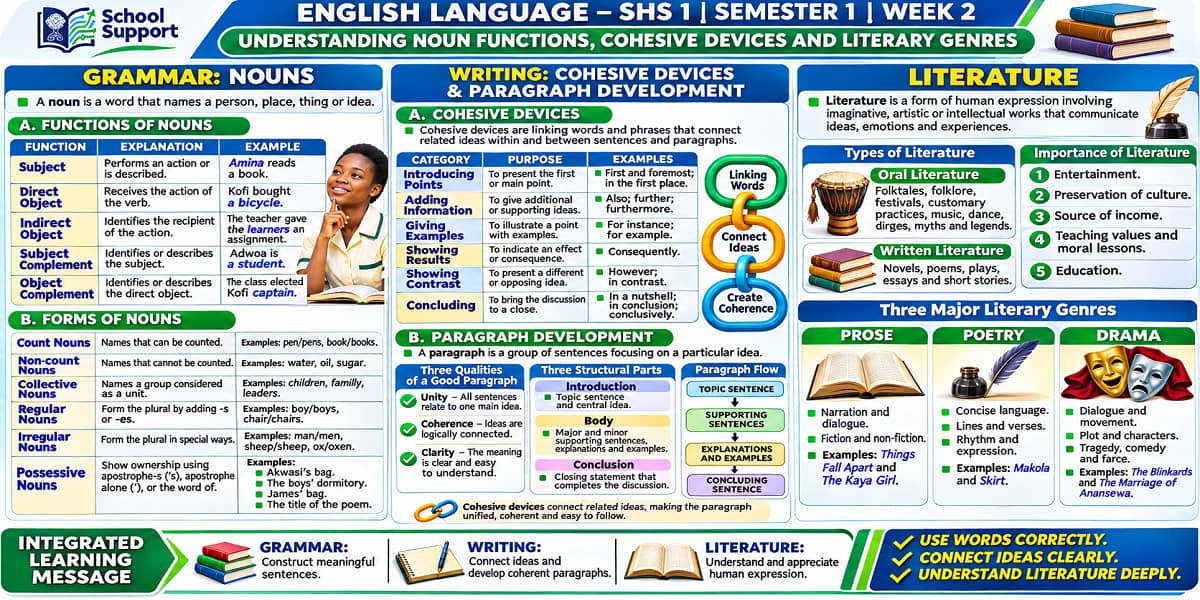
A noun can perform different grammatical functions depending on its position and relationship with other words in a sentence. Five important functions are the subject, direct object, indirect object, subject complement and object complement.
Subject
The subject is the person, place, thing or idea that performs an action or is being described in a sentence.
Example: Amina reads a book.
Amina is the subject because she performs the action of reading.
Direct Object
A direct object receives the action expressed by the verb. It answers the question what or whom after the verb.
Example: Kofi bought a bicycle.
Bicycle is the direct object because it receives the action of buying.
Indirect Object
An indirect object identifies the person or recipient to whom or for whom something is done.
Example: The teacher gave the learners an assignment.
The learners are the indirect object because they are the recipients of the assignment. The word assignment is the direct object.
Subject Complement
A subject complement follows a linking verb and identifies or describes the subject.
Example: Adwoa is a student.
Student is the subject complement because it identifies Adwoa after the linking verb is.
Object Complement
An object complement follows a direct object and identifies or describes that object.
Example: The class elected Kofi captain.
Captain is the object complement because it identifies the position given to Kofi.
3. Comparing the Functions of Nouns
| Function | Role | Example |
|---|---|---|
| Subject | Performs the action or is described. | Amina reads. |
| Direct object | Receives the action. | Kofi bought a bicycle. |
| Indirect object | Receives the direct object. | She gave Kojo a book. |
| Subject complement | Identifies or describes the subject. | Adwoa is a student. |
| Object complement | Identifies or describes the object. | They elected Kofi captain. |
Notice that a noun’s grammatical function depends on how it is used in a sentence. The same noun can perform different functions in different sentences.
4. Forms and Types of Nouns
Nouns can also be classified according to how they are counted, whether they represent groups, how their plural forms are produced and how they express ownership.
Count Nouns
Count nouns refer to things that can be counted individually. They can have singular and plural forms.
Examples: pen/pens and book/books.
You can say one pen, two pens, one book or several books. Their numbers can be expressed directly.
Non-Count Nouns
Non-count nouns refer to substances or things that are not ordinarily counted as separate individual units in their usual sense.
Examples: water, oil and sugar.
We normally say some water, a little oil or a quantity of sugar rather than treating these substances as ordinary countable units.
Collective Nouns
Collective nouns identify groups or collections. Examples presented in this lesson include children, family and leaders.
These words help communicate the idea of several individuals considered together or as a group.
Regular Nouns
Regular nouns generally form their plurals by adding an appropriate ending, commonly -s or -es.
- Boy — boys.
- Chair — chairs.
Irregular Nouns
Irregular nouns do not follow the usual pattern of simply adding -s or -es to form their plurals.
- Man — men.
- Sheep — sheep.
- Ox — oxen.
For example: I have one ox, but he has two oxen.
5. Possessive or Genitive Forms of Nouns
The possessive or genitive form of a noun expresses ownership or possession. It commonly uses an apostrophe with the letter s, an apostrophe alone or an apostrophe after the s in regular plural nouns.
Adding ‘s to Singular Nouns
An apostrophe followed by s can be added to a singular noun to indicate possession.
- Akwasi’s bag.
- Fuseina’s car.
- Dzifanu’s house.
Adding an Apostrophe to Regular Plural Nouns Ending in s
When a regular plural noun already ends in s, an apostrophe is placed after the s to indicate possession.
- The boys’ dormitory.
- The girls’ house.
- Mfantsipim Boys’ School.
Possessive Forms of Nouns Ending in s
For nouns ending in s, the possessive form may be written by adding an apostrophe, as illustrated in the following examples:
- Abass’ book.
- Rawlings’ speech.
- James’ bag.
- Akos’ bicycle.
- St. Roses’ School.
Using Of to Express Possession or Relationship
Possession or relationships can also be expressed using the word of.
- The title of the poem.
- Kudus was the man of the match.
- The wife of Hamza was here.
6. Applying Noun Knowledge in Sentences
Understanding noun forms and functions becomes more useful when you can identify them in actual communication.
Activity 1: Identify the Subject
Read a sentence and identify the person or thing performing the action. For example, in “The children played football”, children is the subject.
Activity 2: Identify Objects and Complements
Examine sentences containing direct objects, indirect objects, subject complements and object complements. Explain the grammatical role of each noun.
Activity 3: Form Possessives
Rewrite expressions to show ownership using appropriate apostrophes or the word of. Examples include Amina’s book, the boys’ dormitory and the title of the poem.
PART TWO: WRITING — COHESIVE DEVICES AND PARAGRAPH DEVELOPMENT
7. Understanding Cohesive Devices
Cohesive devices are expressions used to ensure coherence or the free flow of thought from the beginning to the end of a paragraph.
When writing, individual sentences should not appear as disconnected statements. Readers need to understand how one idea relates to another. Cohesive devices provide signals that help establish these relationships.
For example, a writer may introduce a first point, add another point, provide an illustration, show a contrast and finally draw a conclusion. Appropriate linking expressions make these movements easier to follow.
8. Types and Uses of Cohesive Devices
| Purpose | Cohesive devices |
|---|---|
| Introducing a first point | First and foremost; in the first place. |
| Adding information | Also; further; furthermore. |
| Giving examples | For instance; for example. |
| Showing results | Consequently. |
| Showing contrast | In contrast; however. |
| Concluding | In a nutshell; in conclusion; conclusively. |
| Connecting related ideas | And; before; since; while; as; until. |
Introducing the First Point
Expressions such as first and foremost and in the first place help introduce the initial argument or idea in a discussion.
Adding Another Point
Also, further and furthermore indicate that the writer is introducing additional information connected to an earlier statement.
Providing Examples
For instance and for example introduce illustrations that make an explanation easier to understand.
Showing Results
Consequently indicates a result or outcome that follows from an earlier situation.
Showing Contrast
However and in contrast help communicate differences between ideas or situations.
Concluding an Argument
In a nutshell, in conclusion and conclusively can signal that the writer is bringing a discussion or explanation towards its end.
The choice of a cohesive device should reflect the relationship between the ideas. A linking expression should never be inserted merely to make a paragraph appear sophisticated.
9. Understanding Paragraph Development
A paragraph is a group of sentences that focus on a particular idea. It is not simply an assemblage of unrelated sentences. A good paragraph has unity, coherence and clarity of development.
Unity
Unity means that the sentences in a paragraph should contribute to one central idea. Unrelated information should not distract the reader from the main subject.
Coherence
Coherence means that ideas are connected logically and presented in a meaningful order. Cohesive devices help establish these relationships.
Clarity of Development
Clarity means that the main idea and supporting explanations are expressed in a way that readers can understand without unnecessary confusion.
10. The Topic Sentence and Supporting Sentences
Topic Sentence
The topic sentence expresses the main idea on which the paragraph is developed. It is generally placed at the beginning, although it can also appear in the middle or at the end.
Supporting Sentences
Supporting sentences develop the topic sentence. They may provide explanations, examples, scenarios and illustrations. Some provide major supporting ideas, while others supply additional details.
Consider this example:
Topic sentence: Road accidents have caused a lot of havoc in Ghana.
Supporting sentences: These mostly resulted from illegal overtaking and drunk driving. Excessive speeding has played a major role.
The opening statement introduces the main idea, while the remaining sentences explain factors associated with the issue.
11. The Three Structural Parts of a Paragraph
A developed paragraph can be organised into three parts: introduction, body and conclusion.
Introduction
The introduction presents the subject matter or thesis statement of the paragraph. It indicates the reason or purpose for discussing the subject.
Body
The body contains supporting sentences that develop the thesis statement. It provides explanations, examples, scenarios and illustrations that make the main idea clearer.
Conclusion
The concluding sentence signals that the paragraph has come to an end. It brings the discussion to a meaningful close, while a suitable cohesive device in a subsequent paragraph can introduce another idea.
12. Connecting Sentences into a Meaningful Paragraph
A paragraph becomes effective when its sentences contribute to the same central idea and follow a logical sequence.
For example, a paragraph about the value of education may begin by introducing education as an important part of personal development. Supporting sentences can explain how education develops knowledge and provides opportunities for learning. A concluding sentence can reinforce its importance.
Expressions such as furthermore, for example and in conclusion can help connect these ideas when their meanings suit the relationships being expressed.
Remember that a cohesive device does not replace good thinking. You must first establish the relationship between your ideas before choosing the appropriate expression.
13. From Paragraphs to Essays
Paragraphs are the building blocks of longer written compositions. Several well-developed paragraphs can be arranged to form an essay.
Each paragraph should contribute a meaningful part of the overall discussion. The ideas should progress logically, and appropriate cohesive devices should help readers understand the connections between them.
A story map can also help organise ideas before writing. It can identify the title, setting, characters, problem and solution of a story. These elements provide a useful planning structure for developing an organised written narrative.
PART THREE: LITERATURE — CONCEPT, TYPES, IMPORTANCE AND GENRES
14. Understanding Literature
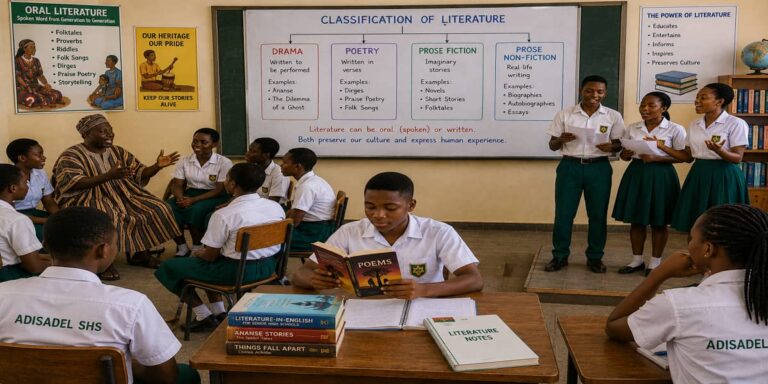
Literature is a form of human expression. It refers to works of imaginative, artistic or intellectual value that use language to communicate ideas, emotions and experiences.
Literature includes novels, poems, plays, essays, short stories and other literary works. Through these forms, people can communicate experiences, preserve cultural knowledge, express emotions and explore different aspects of human life.
Literature is therefore not limited to entertainment. It can also educate, preserve cultural practices and provide opportunities to reflect on values and social experiences.
15. Types of Literature
Oral Literature
Oral literature consists of works of art transmitted by word of mouth. It includes festivals, customary practices, music and dance, folktales, folklore, dirges, myths and legends.
Dirges are ceremonial expressions associated with praising or remembering a deceased person and may take the form of a eulogy.
Oral literature allows cultural expressions and traditional knowledge to be communicated through spoken and performed forms.
Written Literature
Written literature consists of works of art transmitted in written form.
Examples include:
- The Beautiful Ones Are Not Yet Born by Ayi Kwei Armah.
- The Dilemma of a Ghost by Ama Ata Aidoo.
- Raider of the Treasure Trove by Lade Worsonoo.
These works demonstrate how ideas, emotions and experiences can be preserved and communicated through written language.
16. The Importance of Literature
Literature contributes to individual development and society in several important ways.
Entertainment
Literature provides enjoyment through stories, poems, plays and other forms of artistic expression.
Preservation of Culture
Literature helps preserve cultural knowledge, traditions, beliefs and experiences. Oral and written works can communicate important aspects of a community’s heritage.
Source of Income
Literary activities can provide income through writing, publishing and other related creative work.
Teaching Values and Moral Lessons
Literary works can communicate lessons about human behaviour, responsibility and relationships. Readers can reflect on the actions and experiences presented in stories and plays.
Education
Literature can develop understanding by exposing readers to ideas, emotions, experiences and different perspectives.
17. Three Major Genres of Literature
Literature can be classified into three major genres: prose, poetry and drama. Each genre has distinctive characteristics and ways of communicating ideas.
Prose
Prose is a form of written language that typically contains dialogue and narration. It is the most common form of writing in literature. Its two main types are fiction and non-fiction.
Prose is found in novels, short stories, plays and essays as identified in the lesson.
Examples include The Kaya Girl by Mamle Wolo and Things Fall Apart by Chinua Achebe.
Poetry
Poetry is a form of literature that uses language to convey emotions or ideas in a concise and often rhythmic manner. It is written in lines and verses.
Poetry can communicate deep experiences through carefully selected words and artistic expression.
Examples include Makola by Theresah Ennin and Skirt by Niyi Osundare.
Drama
Drama is a genre of literature that tells a story through dialogue and movement. It often has a clear plot and characters who undergo change or development throughout the story.
Drama includes subgenres such as tragedy, comedy and farce.
Examples include:
- The Son of Umbele by Bill Marshall.
- The Blinkards by Kobina Sekyi.
- The Marriage of Anansewa by Efua T. Sutherland.
- A Tribe Called Judah by Funke Akindele.
18. Comparing the Literary Genres
| Genre | Distinctive features | Examples |
|---|---|---|
| Prose | Narration and dialogue; fiction and non-fiction. | The Kaya Girl; Things Fall Apart. |
| Poetry | Concise language, lines, verses and rhythm. | Makola; Skirt. |
| Drama | Dialogue, movement, plot and characters. | The Blinkards; The Marriage of Anansewa. |
19. Recognising Literature in Everyday Life
Literature is connected to human experiences and cultural expression. Folktales, myths, music, dance and customary practices communicate experiences and traditions orally. Written works preserve stories, ideas and emotions for readers.
Understanding literary genres helps you recognise how different works communicate. A poem uses lines and verses, prose commonly uses narration and dialogue, while drama presents stories through dialogue and movement.
PART FOUR: PRACTICE QUESTIONS AND MODEL ANSWERS
20. Grammar: Noun Functions and Forms
Question 1: What is a noun?
Model Answer: A noun is a word that names a person, place, thing or idea.
Question 2: Identify the five functions of nouns.
Model Answer: Subject, direct object, indirect object, subject complement and object complement.
Question 3: Identify the noun functions in the following sentences.
- Amina reads a book.
- Kofi bought a bicycle.
- The teacher gave the learners an assignment.
- Adwoa is a student.
- The class elected Kofi captain.
Model Answers:
- Amina — subject.
- Bicycle — direct object.
- Learners — indirect object; assignment — direct object.
- Student — subject complement.
- Captain — object complement.
Question 4: Differentiate between count and non-count nouns.
Model Answer: Count nouns refer to things that can be counted individually, such as pens and books. Non-count nouns refer to substances or things that are not ordinarily counted as separate units, such as water, oil and sugar.
Question 5: Give two examples each of regular and irregular nouns.
Model Answer:
- Regular: boy/boys and chair/chairs.
- Irregular: man/men and ox/oxen.
Question 6: Rewrite these expressions to show possession: Akwasi, boys, James and the title of the poem.
Model Answer:
- Akwasi’s bag.
- The boys’ dormitory.
- James’ bag.
- The title of the poem.
21. Writing: Cohesive Devices and Paragraph Development
Question 7: What are cohesive devices?
Model Answer: Cohesive devices are expressions used to connect ideas and ensure the coherent flow of thought from the beginning to the end of a paragraph.
Question 8: Give two cohesive devices used for adding information, showing contrast and concluding.
Model Answer:
- Adding information: furthermore, also.
- Showing contrast: however, in contrast.
- Concluding: in conclusion, in a nutshell.
Question 9: What is a paragraph?
Model Answer: A paragraph is a group of sentences that focus on a particular idea and are organised to communicate that idea coherently.
Question 10: State the three structural parts of a paragraph.
Model Answer: Introduction, body and conclusion.
Question 11: Explain the difference between a topic sentence and supporting sentences.
Model Answer: A topic sentence expresses the central idea of a paragraph. Supporting sentences develop that idea through explanations, examples, scenarios and illustrations.
Question 12: State three qualities of a good paragraph.
Model Answer: Unity, coherence and clarity of development.
22. Literature: Concept, Types and Genres
Question 13: Explain literature in your own words.
Model Answer: Literature is a form of human expression involving imaginative, artistic or intellectual works that use language to communicate ideas, emotions and experiences.
Question 14: Identify the two major types of literature.
Model Answer: Oral literature and written literature.
Question 15: State five importance of literature.
Model Answer:
- It provides entertainment.
- It preserves culture.
- It provides a source of income.
- It teaches values and moral lessons.
- It serves as a form of education.
Question 16: Identify the three major genres of literature.
Model Answer: Prose, poetry and drama.
Question 17: Differentiate between prose, poetry and drama.
Model Answer:
- Prose commonly uses narration and dialogue and includes fiction and non-fiction.
- Poetry uses concise and often rhythmic language arranged in lines and verses.
- Drama presents a story through dialogue and movement, involving characters and a plot.
PART FIVE: EXTENDED APPLICATION ACTIVITIES
23. Practical Learning Activities
Activity 1: Analysing Noun Functions
Select a short passage from a newspaper, story or book. Identify at least five nouns and examine their functions in the sentences. Classify each identified noun as a subject, direct object, indirect object, subject complement or object complement where applicable. Present your findings with supporting sentences.
Activity 2: Regular, Irregular and Possessive Forms
Prepare a list of nouns and arrange them into regular and irregular forms. Include examples such as boy/boys, man/men, chair/chairs and ox/oxen. Then construct possessive expressions using an apostrophe, apostrophe-s or the word of.
Activity 3: Building a Coherent Paragraph
Choose a familiar topic and write one paragraph containing a clear topic sentence, supporting sentences and a concluding sentence. Use suitable cohesive devices to introduce points, add information, provide examples and conclude the discussion.
Activity 4: Developing a Two-Paragraph Essay
Write a two-paragraph essay on a topic of your choice. Ensure that each paragraph has a central idea and supporting sentences. Use appropriate cohesive devices to connect the ideas within each paragraph and establish a logical relationship between the two paragraphs.
Activity 5: Organising a Story Map
Choose a story and prepare a story map identifying its title, setting, characters, problem and solution. Use these elements to organise your ideas before developing introductory, body and concluding paragraphs.
Activity 6: Exploring Literature
Identify examples of oral and written literature. Explain how each form communicates ideas, emotions, cultural experiences and values. Classify selected works as prose, poetry or drama and justify your decisions using their characteristics.
Activity 7: Evaluating the Importance of Literature
Identify four ways literature contributes to everyday life. For each one, explain its importance, provide a relevant real-life situation and identify a literary work that illustrates the point.
Conclusion: Bringing Grammar, Writing and Literature Together
Effective communication depends on the ability to use words correctly, connect ideas logically and understand the different ways language communicates human experiences.
Knowledge of noun functions helps you recognise how naming words operate within sentences. Understanding count, non-count, collective, regular, irregular and possessive forms improves grammatical accuracy.
Cohesive devices help connect ideas, while proper paragraph development ensures that written communication has unity, coherence and clarity. Understanding literature introduces you to oral and written expressions and the major genres of prose, poetry and drama.
These abilities reinforce one another. Accurate grammar supports good writing, organised writing communicates ideas effectively and literature develops an appreciation of language as a means of artistic and intellectual expression.
Final Self-Check
Before completing this lesson, confirm that you can:
- Identify the five grammatical functions of nouns.
- Distinguish count, non-count and collective nouns.
- Recognise regular and irregular noun forms.
- Construct possessive expressions correctly.
- Explain cohesive devices and select them according to their purposes.
- Identify topic sentences and supporting sentences.
- Explain unity, coherence and clarity in paragraph development.
- Develop paragraphs using introduction, body and conclusion.
- Define literature and distinguish oral from written literature.
- Explain the importance of literature.
- Identify prose, poetry and drama using their characteristics.
Final Application: Write two connected paragraphs on the importance of education. Use appropriate nouns and cohesive devices. After completing the paragraphs, identify the grammatical functions of selected nouns, underline the topic sentences and supporting sentences, and explain how the conclusion completes each paragraph.
Access NaCCA-aligned Support Packs
Download your structured NaCCA-aligned Teacher Support Pack and Student Learning Pack, designed for clarity, practicality, and reliable teaching and learning.