Formal and Informal Language, Descriptive Writing, Monologues and Dialogues – SHS 1 English Language (Semester 1, Week 6)
Introduction: Using Language to Communicate Meaning
Imagine speaking with your closest friend and then addressing your school’s headteacher. Would you use exactly the same vocabulary in both situations? Consider writing a story about an unforgettable experience. How would you arrange the events, describe what happened and make the experience interesting to readers? In a play, how can a character communicate personal thoughts without speaking to another person?
These questions highlight important aspects of English Language learning. Effective communication requires appropriate vocabulary, organised writing and an understanding of how speech is used in literary texts.
This week’s learning explores three areas: language use in different contexts, descriptive writing through the structure of a linear narrative essay, and monologues and dialogues in narratives and plays.
1. Language Use in Different Contexts
People do not communicate in exactly the same way in every situation. The vocabulary used when speaking with friends may differ from the language appropriate for communicating with school authorities, employers or other officials.
The same principle applies to writing. A friendly message may use familiar expressions, while an official letter requires carefully selected and more formal vocabulary.
The variety of language used according to a particular situation is associated with register.
2. Understanding Formal Language
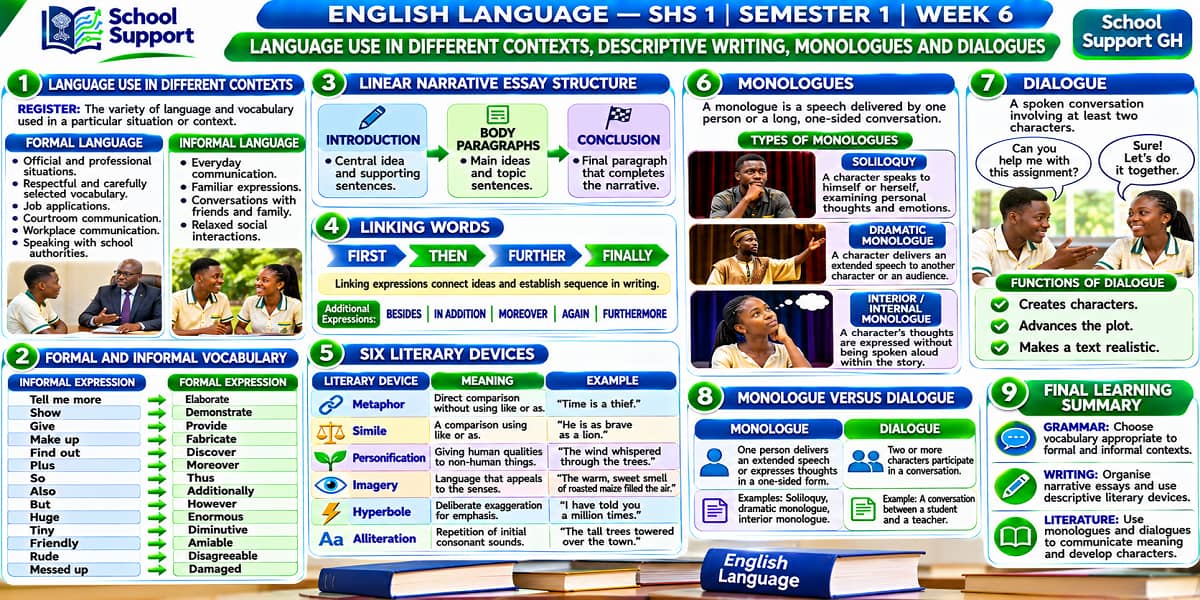
Formal language is used in official, professional and other situations where polite, respectful and carefully selected expressions are expected.
Examples of formal situations include visiting the headteacher’s office, the post office, Parliament House, a chief’s palace or a courtroom. Formal language is also appropriate for job applications, curricula vitae and workplace communication.
Consider this extract from a formal job application:
“I believe I will be an asset to your company. I have attached my resume and references as requested. I value your consideration of my application. I look forward to hearing from you.”
The language is professional and respectful. It communicates the applicant’s intentions without relying on casual expressions.
3. Understanding Informal Language
Informal language is commonly used in relaxed everyday communication among friends, family members and familiar people.
It allows speakers to communicate naturally using familiar vocabulary and conversational expressions.
For example, a learner may say, “Just give me a minute, I will be right back” when speaking with friends. In a classroom, the same learner may ask, “May I go out, Madam?”
The difference is not necessarily the intention but the context in which the communication takes place.
4. Formal and Informal Vocabulary
Many everyday expressions have formal alternatives that may be more appropriate in official or professional communication.
Examples from the Week 6 learning material include:
| Informal | Formal |
|---|---|
| Tell me more | Elaborate |
| Show | Demonstrate |
| Give | Provide |
| Make up | Fabricate |
| Find out | Discover |
| Plus | Moreover |
| So | Thus |
| Also | Additionally |
| But | However |
| Meanwhile | In the interim |
| In a nutshell | Essentially |
| Huge | Enormous |
| Tiny | Diminutive |
| Okay | Acceptable |
| Friendly | Amiable |
| Rude | Disagreeable |
| Messed up | Damaged |
These vocabulary alternatives demonstrate how speakers can adjust their expressions to suit different situations. However, the appropriate alternative must always preserve the intended meaning of the sentence.
5. Register in Everyday Ghanaian Situations
Register is not limited to formal letters and professional communication. It also affects everyday interactions.
When speaking with a headteacher, a learner may use respectful expressions. When communicating with friends, the learner may use familiar and relaxed vocabulary.
At a funeral ground or religious service, the language should reflect the seriousness and sensitivity of the occasion. When addressing a political leader, formal expressions are appropriate.
Similarly, asking a senior member of the school to have an examination paper remarked requires polite and carefully selected vocabulary.
Recognising these differences helps speakers communicate appropriately without causing unnecessary misunderstanding.
6. Descriptive Writing: Creating Clear Mental Pictures
Descriptive writing involves selecting precise words and expressions to create a vivid picture of experiences, people, places, objects and events.
It enables readers to imagine what the writer is describing rather than simply receiving a list of events.
The Week 6 learning material focuses on writing short stories using precise words and phrases to communicate vivid experiences. It places particular emphasis on the structure of a linear narrative essay.
7. Structure of a Linear Narrative Essay
A linear narrative essay presents events in an organised sequence so that readers can follow the development of the story.
Its structure consists of three major sections: the introductory paragraph, body paragraphs and concluding paragraph.
Introduction: This is the opening section. It introduces the central idea of the essay and includes supporting sentences that establish the direction of the composition.
Body paragraphs: These develop the main ideas of the essay. Each paragraph contains a topic sentence that introduces its central point, followed by supporting information.
Conclusion: This is the final paragraph. It brings the composition to a meaningful close and completes the presentation of the narrative.
8. Developing an Effective Introduction
The introductory paragraph establishes the central idea of the entire essay.
It should introduce the subject clearly and provide supporting sentences that prepare readers for the ideas developed in the body paragraphs.
For example, an essay about an unforgettable school excursion may introduce the journey, explain why it was important and establish the experience that the narrative will describe.
A well-organised introduction gives readers a clear understanding of the direction of the composition.
9. Developing Body Paragraphs
Body paragraphs form the main part of a narrative essay.
Each paragraph should develop a main idea through an appropriate topic sentence and supporting information.
In a linear narrative, the writer should organise the events so that readers can understand how one experience leads to another.
For example, a narrative about a school excursion may describe preparations first, the journey next, the activities that followed and the experiences that made the excursion memorable.
10. Writing an Effective Conclusion
The concluding paragraph brings the narrative to an end.
It should connect naturally with the events presented in the body paragraphs and provide a suitable closing statement.
A conclusion should not introduce unrelated information. Instead, it should complete the narrative and leave readers with a clear understanding of the experience.
11. Linking Words and Expressions
Linking words connect sentences and paragraphs. They help readers understand the sequence and relationship between ideas.
Expressions identified in the Week 6 learning material include:
- First: Introduces the initial point or event.
- Then: Shows what happens next.
- Further: Introduces additional development.
- Finally: Indicates the last stage or event.
- Besides: Adds another related point.
- In addition: Introduces further information.
- Moreover: Adds a related idea.
- Furthermore: Provides additional information.
These expressions improve coherence by helping writers connect ideas logically.
12. Literary Devices in Descriptive Writing
Literary devices make narratives more expressive and help writers communicate experiences vividly.
The learning material identifies six devices.
Metaphor: A direct comparison in which one thing is described as another without using like or as.
Example: “The classroom was a beehive of activity.”
Simile: A comparison between different things using like or as.
Example: “The boy ran like the wind.”
Personification: Giving human qualities or actions to non-human things or abstract ideas.
Example: “The wind whispered through the trees.”
Imagery: Descriptive language that appeals to the senses and creates mental pictures.
Example: “The golden sunlight spread across the quiet green fields.”
Hyperbole: Deliberate exaggeration used for emphasis or effect.
Example: “I have told you a thousand times.”
Alliteration: Repetition of the same initial consonant sound in closely connected words.
Example: “Peter picked plenty of purple petals.”
Using these devices appropriately makes writing more vivid and interesting.
13. Understanding Monologues
A monologue is a speech delivered by one person or a long, one-sided conversation.
In literary works, monologues allow characters to express thoughts, emotions, experiences and personal perspectives through extended speech or the presentation of internal thoughts.
Three types are discussed in the Week 6 learning material: soliloquy, dramatic monologue and interior/internal monologue.
14. Soliloquy
A soliloquy is a monologue in which a character delivers a long speech to himself or herself rather than to another character or the audience.
It allows the character to examine personal thoughts, emotions or difficult circumstances.
For example:
“I have worked so hard to reach this moment. Yet I am afraid of what lies ahead. Should I take the risk, or should I remain where I am? I must find the courage to make this decision.”
The character is speaking privately while examining an important personal decision.
15. Dramatic Monologue
A dramatic monologue is a long speech delivered by a character to another character or to the audience.
Such speeches tend to be lengthy and are often not interrupted by other characters.
Example:
“You have heard many stories about what happened that day, but nobody has asked me what I experienced. I stood alone when everyone else turned away. I made the decision because someone had to take responsibility.”
The character communicates an extended perspective to another person or an audience.
16. Interior or Internal Monologue
An interior or internal monologue expresses a character’s thoughts without those thoughts being spoken aloud within the world of the story.
For example, a stage production may display a character’s thoughts on a screen while that character is participating in a conversation. The audience can therefore understand what the character is thinking even though those thoughts are not spoken.
This technique helps communicate the distinction between a character’s private thoughts and public speech.
17. Understanding Dialogues
A dialogue is a spoken conversation involving at least two characters.
Dialogues are important in narratives and plays because they show characters communicating and responding to one another.
They perform three major functions:
Creating characters: Conversations reveal the personalities, attitudes and relationships of the characters.
Advancing the plot: Dialogues introduce information, develop problems and help move events forward.
Making a text realistic: Conversations make literary works more natural by showing how people interact through speech.
18. Monologue and Dialogue: Understanding the Difference
A monologue involves one person delivering an extended speech or communicating thoughts in a one-sided form. A dialogue involves at least two characters participating in a conversation.
For example, a character speaking alone about a difficult decision demonstrates a monologue. Two characters discussing that decision demonstrate dialogue.
Both forms contribute to literary meaning, but they serve different purposes in narratives and plays.
19. Using Monologues and Dialogues Together
Writers can combine monologues and dialogues to create more meaningful narratives.
A character may begin with a soliloquy revealing personal uncertainty. The same character may later discuss the problem with another person through dialogue.
The monologue provides insight into the character’s thoughts, while the dialogue reveals the character’s relationships and interactions.
This combination can develop characterisation, advance the plot and make a narrative more engaging.
20. Practical Application: Writing a Narrative
The Week 6 learning material challenges learners to write a story illustrating the saying “No pain, no gain.”
This activity requires learners to organise their ideas into a linear narrative, use appropriate vocabulary and apply descriptive techniques.
A successful composition should contain an introductory paragraph establishing the central idea, body paragraphs presenting the events in sequence and a concluding paragraph bringing the narrative to an end.
Linking expressions should help readers follow the events. Literary devices can make the experiences more vivid. Monologues and dialogues can be incorporated to reveal characters’ thoughts and interactions.
Learners are also encouraged to write a story on a topic of their own, applying the same principles of organisation and expression.
Conclusion: Developing Communication, Writing and Literary Skills
English Language proficiency requires the ability to select suitable vocabulary, organise ideas and understand how language creates meaning in literary works.
Formal and informal language use develops contextual awareness. Descriptive writing strengthens the ability to communicate experiences through precise vocabulary, coherent paragraphs and literary devices. Monologues and dialogues help writers reveal characters’ thoughts, create realistic interactions and develop narratives.
Through regular reading, role-play, group discussions and independent writing, learners can apply these skills to everyday communication and creative expression.
Check Your Understanding
Can you identify situations requiring formal and informal language? Can you select suitable vocabulary for each context? Can you organise a linear narrative essay using an introduction, body paragraphs and conclusion? Can you use linking words and literary devices effectively? Can you distinguish among soliloquy, dramatic monologue, interior monologue and dialogue?
Use these questions to review your understanding and identify areas that require further practice.
Access NaCCA-aligned Support Packs
Download your structured NaCCA-aligned Teacher Support Pack and Student Learning Pack, designed for clarity, practicality, and reliable teaching and learning.